Andrew Hageman
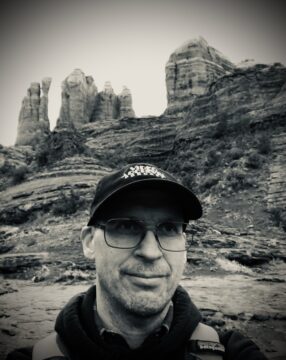
Director of the Center for Ethics and Public Engagement
About
Education: Ph.D., English with Designated Emphasis in Critical Theory, University of California, Davis; M.A., English, Western Washington University; B.A., English, St. Olaf College, Phi Beta Kappa
Andy Hageman directs The Center for Ethics and Public Engagement and teaches courses for the English department, Visual Communication program, and Paideia first-year and capstone program. His regular course offerings include Film, Film in Focus (Science Fiction, Horror), Global Weirding, How Literature Works, and Paideia capstone ethics courses.
During January-Term (2025) Andy co-taught the study away course “Building Ethical Futures through Design, Architecture, and Narrative in Norway.” Through interactive site visits to Snøhetta, Future Library, The Nansen Academy, among others, our students explored and learned about Norwegian approaches to making abstract values and ideologies concrete–figuratively and literally.
Andy researches entanglements of ideology, ecology, & technology. Recently he’s published a chapter co-written with Regina Kanyu Wang in Ecocinema Theory & Practice 2, “The Wood for the Trees: Regional and Anthropocene Signals in the Pacific Northwest Forests of Twin Peaks” in David Lynch and the American West, “Engaging Students and Global Weirding” in the MLA Press volume Teaching the Literature of Climate Change, and a review essay on the film Werewolves Within in the journal Gothic Nature.
Check out Andy’s popular culture journalism on David Lynch & Twin Peaks or on horror film, lit, & theory.
ENG 352: American Literature to 1860
American writers since the very beginnings have inscribed the natural landscape and crossed frontiers of the human heart and soul. We will explore these frontiers and the authors who transcend boundaries into uncharted space in stories of Spanish conquistadors and Native Americans; the narratives of English colonists, African-American slaves, and explorers Lewis and Clark; nature essays of Emerson and Thoreau, illustrated by the Hudson Valley School; poetry by Bradstreet, Wheatley, Whitman, and Dickinson; fiction by Hawthorne, Melville, and Beecher Stowe.
ENG 353: American Lit 1860 To Present
An invitation to explore currents and crosscurrents, traditions and individual talents, movements and masterpieces from the Civil War era to the present. Works will be chosen from a variety of genres, and course units may emphasize particular regions, periods, or themes, such as Southern voices (Faulkner, Hurston, Welty), the era of World War I (Hemingway, Cummings, Dos Passos), and feminist fiction and poetry (Kingston, Walker, Sexton).
ENG 185 A: Eco-Media
Since the Lumière brothers conducted one of the earliest public film screenings in 1895, people have recognized cinema as a powerful medium for documenting moving images and for telling stories. Recently, people have turned to film to inspire people to think and act ecologically. This course explores how various cinematic media shape the ways we understand and represent ecological issues and potentially sustainable futures. We will move through documentaries, fiction features, and digital transmedia texts as well as the Decorah Eagle Cam. Students will acquire the ability to analyze various approaches to narrating ecological issues through discussion and in writing. They will also produce their own eco-media projects to post on the Internet.
ENG 211: Writing for Media
A comprehensive course in news writing, reporting, and writing for media. Focus on the issues and skills central to journalism, and professional writing for various media. Readings and examples from newspapers, on-line and print magazines, and electronic journalism.
ENG 247: Literature and Ecology
What kinds of stories help us confront, ignore, deny, or re-imagine the ecological challenges we face? How do we use narratives and poetry to perceive and imagine ecosystems? And why do we think things like mountains, wind turbines, fjords, limestone, bonobos, the influenza virus, or snow-globes are beautiful or ugly, natural or unnatural? This course explores how literature and other cultural texts shape the ways we think about and act in the biophysical world and the systems that comprise it. Readings will vary by may come from traditions of nature writing; explorations of place, space, and time; connections between religion and ecology; relationships linking literature and science; and intersections of ecology and social issues like ability, class, gender, and race.
ENG 354: American Novel
A study of major American novelists from the mid-19th century to the present, such as Melville, Stowe, Twain, Cather, Faulkner, and Morrison. Some attention is given to theoretical approaches to American literature.
PAID 450: Archaeologies of the Future
We cannot change the past. We can try to live in the present. But it is only into the future that we can project our hopes for and fears of change. The future is a time and place that remains open. To be sure, the shape of things to come is influenced by the shapes of things that already exist, and yet, the future is not entirely predictable. This course explores a range of fictional and non-fictional imagined futures from various places and times with a particular focus on three main areas: Social Structures, Technology, and Environment. We will excavate past and contemporary visions of the future in order to learn how predictions, and the ethical positions from which they are built, are subject to the ideas of their times and places and to examine which factors influence the success or failure of these visions. The future, after all, is the site and the stakes of our ethical imagination and action in the present.
- Ph.D., English, Designated Emphasis: Critical Theory, University of California, Davis, 2005-2011
Dissertation: “The Hour of the Machine” - M.A., English, Western Washington University, 2003-2005
Thesis: “Moving Mountains: Han Shan’s Poetic Body Crossing Oceans, Lands, and Time” - B.A., English, St. Olaf College, 1992-1996
Phi Beta Kappa
I research techno-cultural history, intersections of ecology and literature, film, and other media, and speculative fiction. Most recently, I co-edited an issue of the journal Paradoxa with the theme “Global Weirding” that features some excellent scholarly essays and riveting interviews that paired China Miéville with Mark Bould and Jeff VanderMeer with Timothy Morton. Currently I’m working on a book that explores the roles of infrastructure in speculative fiction with a particular focus on how economic and ecological ideologies are made concrete and therefore visible in things like bridges, border walls, telecom networks, oil rigs, and roads.
I love to involve Luther students in my research when possible. This summer, Katie Patyk, an English and History double major, and I completed a student-faculty collaborative research project that involved combing a special collection archive of letters that Theodore Sturgeon exchanged with other writers like Ray Bradbury, Octavia Butler, and John Campbell.
In recent years, students have been my research assistants on projects concerning representations of science stations in fiction and in the non-fiction world, on science fiction writers’ responses to the launch of Sputnik, and on the allegorical function of pie and coffee in Twin Peaks.
I’m always on the lookout for students who are intellectually curious and diligent to join me in doing research.
- “‘For 25 Years I’ve Kept Something From You’: Twin Peaks in Print.” Los Angeles Review of Books. (16 January 2018).
- “’The key to this immense metallized landscape’: Reading J.G. Ballard’s Crash as an Ecological Structure of Feeling.” Extrapolation. (Forthcoming, 2018).
- “Tricking the Troll: An Interview with Berit Ellingsen on the Anthropocene and Literature.” C21 Literature: Journal of 21st Century Writings. (Forthcoming, 2017).
- “With Love from Iceland.” Alluvium: 21st Century Writing / 21st Century Approaches. (May 2017).
- “A Robot Runs through It: Žižek And Ecocriticism.” Everything You Always Wanted to Know about Literature but Were Afraid to Ask Slavoj Žižek. Edited by Russell Sbriglia. Durham, NC: Duke University Press, 2017.
- “The Uncanny Ecology of Mulholland Drive.” Reprinted in Back to Mulholland Drive: Minimal Fantasy. Edited by Nicolas Bourriaud for the exhibition “Return to Mulholland Drive” at La Panacée Center of Contemporary Culture, Montpellier, France. 2017.
- “Signals of Nature, Prestidigital Ecology.” Reprinted in Digital Environments. Edited by Sid Dobrin. New York: Taylor & Francis. (2017, forthcoming).
- “Salvage Love”—Book Review of Borne by Jeff VanderMeer. Los Angeles Review of Books. (29 April 2017).
- “A Conversation between Timothy Morton and Jeff VanderMeer.” Los Angeles Review of Books. (24 December 2016).
- “A Generic Correspondence: Sturgeon-Roddenberry Letters on SF, Sex, Sales, and Star Trek.” Science Fiction Film & Television. 9.3 (Fall 2016).
- “Infrastructural Anthropology for the Anthropocene in Tom McCarthy’s Satin Island.” Alluvium: 21st Century Writing / 21stCentury Approaches. (Fall 2016).
- “When EcoMedia Gets Weird: Björk—Timothy Morton—Anthropocene.” TMQ: Teaching Media Quarterly. 4.3 (Fall 2016).
- “A Robot Runs through It: Žižek And Ecocriticism.” Everything You Always Wanted to Know about Literature but Were Afraid to Ask Slavoj Žižek. Edited by Russell Sbriglia. Durham, NC: Duke University Press, (2016, forthcoming).
- (With Ashenafi Beyene). “Crumbs Buzz.” Deletion: The Open Access Online Forum in Science Fiction Studies. Episode #11 (8 January 2016).
- “Dialectics of Our Eco-Technical Future Across William Gibson’s Science Fiction.” Paradoxa Volume 27 (December 2015)
- “’August on Sourdough’: An Archival View of Gary Snyder’s Intercultural Poetics.” Western American Literature. 50.2 (Summer 2015).
- “Space-Alien Space.” Science Fiction Research Association Review. 310 (Fall 2014).
- “Karel Čapek Energies: The Absolute at Large as Proto-Cli-Fi Literature.” Deletion: The Open Access Online Forum in Science Fiction Studies. Episode #7 (6 October 2014).
- “Dale Cooper and the Mouthfeel of Twin Peaks.” Food on Film: Bringing Something New to the Table. Ed. Thomas J. Hertweck. New York: Scarecrow Press. (December 2014)
- “Signals of Nature, Prestidigital Ecology.” Green Letters: Studies in Ecocriticism. Digital Environments and Virtual Worlds Issue. (Autumn 2014)
- “Wheels within Wheels,” Ecology, and the Horrors of Mechanophobia.” Interdisciplinary Studies in Literature and Environment. 21.3 (Summer 2014).
- “Other from an Other Other: Science and Fiction in Human-Alien Encounters.” Agora: Luther College in Conversation. 26.2 (Spring 2014) (With Eric Baack)
- “Dead Whale Watching.” Evental Aesthetics. 2.2 (2013).
- “Dismembering the Cautionary Cliché: Re-Reading the Techno-Science Ethics in Mary Shelley’s Frankenstein.” Excursions. (2013)
- “Science Fiction, Ecological Futures, and the Topography of Fritz Lang’s Metropolis.”
Ecozon@: European Journal of Literature, Culture and Environment. 3.2 (2012): 57-73. - “Paolo Bacigalupi’s The Windup Girl and the Challenges of Imagining Ecological Futures.” Science Fiction Studies, 39 (2012): 283-303.
- “Ecocinema and Ideology: Do Ecocritics Dream of a Clockwork Green?” Ecocinema Theory and Practice. Eds. Salma Monani, Sean Cubitt, et al. New York: Routledge Press, (2012).
- “When Nature Calls: Or, Why Ecological Criticism Needs Althusserian Ideology.” Polygraph “Ecology and Ideology” Issue featuring Slavoj Žižek 22 (2010).
- “Floating Consciousness: The Cinematic Confluence of Ecological Aesthetics in Suzhou River.” Chinese Ecocinema in the Age of Environmental Visibility. Eds. Sheldon Lu and Jiayan Mi. Hong Kong University Press, 2009.
- “The Uncanny Ecology of Mulholland Drive.” Scope: An Online Journal of Film & TV Studies. 11 (June 2008).
- (with Sharada Balachandran-Orihuela). “The Virtual Realities of the U.S./Mexico Border in Sleep Dealer and Maquilapolis.” Environmental Communication: A Journal of Nature and Culture. 5.1 (June 2011).
- (with Salma Monani). “Ecological Connections and Contradictions: Penguins, Robots and Humans in Hollywood’s ‘Nature’ Films.” Hollywood’s Exploited: Public Pedagogy, Corporate Movies, and Cultural Crisis. eds. Ben Fryer et al. New York: Palgrave Macmillan, 2010.
- Book Review of: Satin Island by Tom McCarthy. Science Fiction Research Association (SFRA) Review. Vol. 313 (Summer 2015)
- Book Review of: They Live (Cultographies). Extrapolation. (Summer 2015)
- Book Review of The Peripheral by William Gibson. Tweed’s Magazine of Literature and Art: Book Blog. (October 2014).
- Book Review of: Green Planets: Ecology and Science Fiction. Ed. Gerry Canavan and Kim Stanley Robinson. ISLE: Interdisciplinary Studies in Literature and Environment 21.3 (Summer 2014)
- Book Review of: The Textual Life of Airports: Reading the Culture of Flight by Christopher Schaberg. Western American Literature 48.4 (Winter 2014).
- Book Review of Derrida, Africa, and the Middle East by Christopher Wise. Christianity and Literature 63:1 (Autumn 2013).
- Book Review of Telemorphosis: Theory in the Era of Climate Change. Ed. Tom Cohen. ISLE: Interdisciplinary Studies in Literature and Environment 20.2 (Spring 2013).
- Book Review of Red Moon by Benjamin Percy. The Coffin Factory: Online Bits (16 May 2013).
Presentations
- “Imagining Belts, Roads, & Walls: Infrastructure in Contemporary Chinese SF.” Mechademia, Minneapolis College of Art and Design, 22-24 September.
- “Pipelines & Rigs, Pylons & Wires: The Strange Infrastructures of China Miéville.” WorldCon, Helsinki, 8-13 August.
- “Speculating on Futures for the Common Good in China: ‘Folding Beijing’.” The Association for Core Texts and Courses (ACTC), Dallas, 20-23 April.
- “Roundtable: Global Weirding.” SLSA: Creativity. Atlanta, GA, 3-6 November.
- “Posthuman Bodies & Intelligences in Science Fiction.” Lecture given to First-Year Experience Students & Faculty at Trinity University, San Antonio, TX, 15 September 2016.
- “Global Weirding: A Humanities Publishing Case Study.” Faculty Research Symposium. Luther College, October 8, 2016.
- “Space-Alien Spaces: The Weird Ecologies of Michel Faber’s Under the Skin and Jonathan Glazer’s Cinematic Adaptation.” Defying Genre: Michel Faber. Inverness College UHI, July 21-22, 2016.
- “A Robot Runs Through It: Bringing Karel Čapek’s R.U.R. into a Core Texts Course.” The Association for Core Texts and Courses (ACTC), Atlanta, April 14-17, 2016.
- “Red Mars, Red Plenty: Literary Dialectics of Scientific Community Life” SLSA: After Biopolitics, Rice University, November 12-15, 2015
- “Lamas in Space, Letters from Sturgeon: Two Tales from the Archives” Luther College Faculty Research Symposium, September 19, 2015
- “Science Fiction, Media Archaeology, Ecocinema Pedagogy” ASLE “Notes from Underground: The Depths of Environmental Arts, Culture and Justice” University of Idaho, June 23-27, 2015
- “Signals of Nature, Prestidigital Ecology” Luther College Faculty Research Symposium, October 14, 2014
- “A Robot Runs Through It: Žižek and Mechanical Ecocriticism” Žižek Studies Conference 2014, University of Cincinnati, April 4-6, 2014
- “When Cogs Narrate Machines” Marxist Reading Group Annual Conference, University of Florida, March 27-30, 2014
- “Other from an Other Other: Science and Fiction in Human-Alien Encounters.” (Co-presented with Dr. Eric Baack) Paideia Texts & Issues Lecture Series at Luther College. February 18, 2014
- “Astronauts, Radio-Waves, & Crypts: The Media Ecologies of Tom McCarthy’s C and Craig Baldwin’s Spectres of the Spectrum” SLSA “PostNatural” Notre Dame University, Oct. 3-6, 2013
- “Weather Machines Involved and Involving” ASLE “Changing Nature: Migrations, Energies, Limits,” University of Kansas, Lawrence, May 28-June 1, 2013
- Co-Chair and Discussion Panelist: “Topographies of Professionalization: Nearing the Market(s)” and “Topographies of Professionalization: Early Career Planning” ASLE “Changing Nature: Migrations, Energies, Limits,” University of Kansas, Lawrence, May 28-June 1, 2013
- “Ezekiel, William Blake, Klaatu: ‘Wheels within Wheels’ as an Eco-SF Trope” Eaton Science Fiction/SFRA Conferece “Science Fiction Media,” UC Riverside, April 11-14, 2013
- “Cogs vs. the Circuits of Neoliberal Capitalism” Society for Literature, Science and the Arts: SLSA Annual Conference, Milwaukee, WI, September 27-30, 2012
- “How Does a Cog See itself from Inside the Machine?” Žižek Studies Conference 2012, SUNY Brockport, April 28-29, 2012
- “EcoMedia & iPadeology” Society for Cinema and Media Studies (SCMS) Annual Conference, Boston, March 21-25, 2012
- Chaired “Ecocinema II” Panel, Society for Cinema and Media Studies (SCMS) Annual Conference, Boston, March 21-25, 2012
- “Google Books and the Prospects of Distant Reading” The Past, Present, and Future of the Book: ACM Conference, Cornell College, February 3-4, 2012
- Invited Keynote: “Suzhou River and the Aesthetics of Ecological Trauma on Film” Pain and Trauma in East Asian Cinema, UC San Diego. May 14, 2011
- “Ecology, Economy, Geopolitics, and the Posthuman: The Windup Girl as Novel of Myths and Contradictions” Science Fiction Research Association Annual Conference, Phoenix, AZ. June 24-27, 2010
- Co-chair with Michael Ziser of “Ecological Media” Pre-Conference Seminar. ASLE: Association for the Study of Literature and Environment Biennial Conference, University of Victoria, Victoria, B.C., Canada. June 3-6, 2009
- Presented “’The ____in the____’: Mediated Meetings of Plants and Machines” ASLE: Association for the Study of Literature and Environment Biennial Conference, University of Victoria, Victoria, B.C., Canada. June 3-6, 2009
- Chair of Panel “Ecocriticism and Cinema: Reading Ecology in Popular Film”
- Presented “Projecting Systems of Ecology: An Ecocritical Reading of Cybernetics in Popular Cinema”ASLE Biennial Conference, Wofford College, Spartanburg, SC. June 12-16, 2007
- “From Fenyang to The World: Ecocriticism and Jia Zhangke’s Socio-Cinematic Landscapes” Spaces of Conflict, SFSU: San Francisco, CA. November 2-3, 2006
- “Herzog and Treadwell Lost in the Grizzly Gaze: Grizzly Man and Eco-Cinema” Film & History League Annual Conference, Dallas, TX. November 8-12, 2006
- “Floating Consciousness: Suzhou River Overflowing the Transnational Shores of Fiction Film Narration” ACSS Biennial Conference, Shanghai University, Shanghai, P.R. China. June 6-10, 2005
- “Patterns in American Re-Productions of Chinese Eremitic Poetry: Mapping Translations of Han Shan” Production/Reproduction: an inquiry into post-national imaginaries, University of Washington, Seattle, WA. 2004