Derek R. Sweet
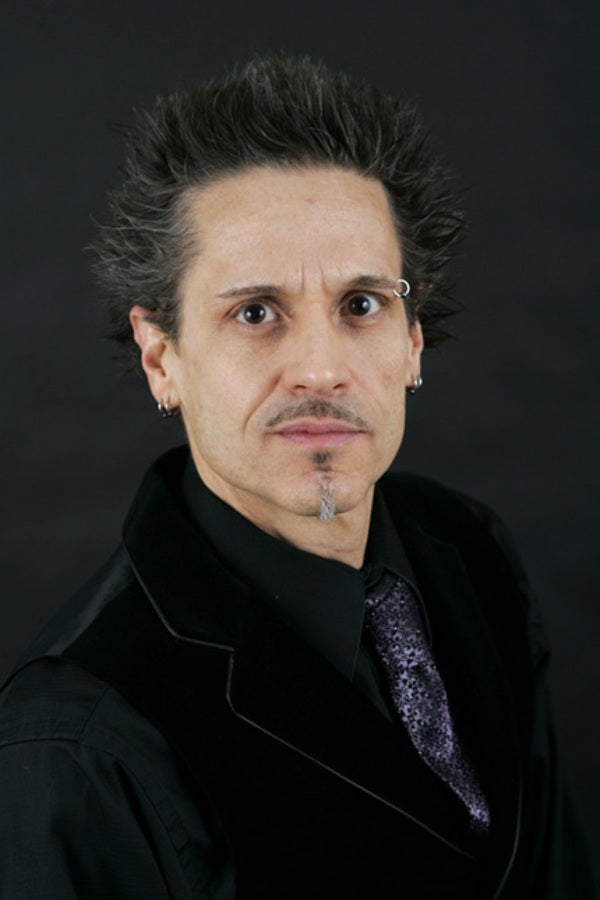
Communication Studies Department Head
About
Education: Ph.D., Human Communication Studies, University of Denver
Derek Sweet has been a professor in the communication studies department since 2005, focusing on the topics of rhetoric and public address. Some of his course topics include Public Address, Advanced Public Address, Rhetoric of Everyday Life, Rhetoric of Spirituality, and Media & Popular Culture.
COMS 132: Public Address
This course examines the principles of speech composition, organization, delivery, and critique. The primary aim of this course is to situate students as critical participants in a variety of public dialogues, dialogues that are crucial to the continued health of a democratic society. Emphasizing critical thinking, thorough research, and rhetorical strategies, students develop their own speaking voice through a series of public performances.
COMS 232: Superheroes as Social Justice Warriors
This course explores the way superhero narratives contribute to an understanding of contemporary life. Through an in-depth analysis of mediated artifacts (e.g. comic books, films, and television programs), as well as an exploration of the approaches taken by popular culture theorists and critics, students examine how dominant societal discourses, cultural myths, individual identities, and institutional ideologies are reinforced and challenged.
COMS 233: Rhetoric of Spirituality
Engaging a variety of traditions (e.g. Christianity, Judaism, Islam, Buddhism, Taoism, Wicca, New Ageism), Rhetoric of Spirituality explores the relationship between communication, U.S. American popular culture, and spiritual practice. Utilizing the fundamentals of rhetorical analysis–close textual reading, thematic interpretation, and critical judgment–the course examines the role of religion and spirituality in public dialogue. Throughout the course, students study how popular spiritual texts like political speeches, feature films, television shows, and written works contribute to the communicative creation, maintenance, and reconceptualization of self, other, and spiritual ideologies.
COMS 234: Popular Culture
This course examines the intersection of rhetoric, popular culture, and broader cultural contexts. During the course of the semester, students explore how people employ popular culture texts (e.g. film, television, fashion, music, architecture, public art) as a means of constituting, negotiating, and transforming the cultures and communities in which they live.
COMS 333: Rhetoric of Identity and Difference
This course examines the role of rhetoric in such significant identity categories as race, ethnicity, sexuality, gender, nationality, and ability. Focusing on historical and contemporary political discourse, protest movements, and media representations, students examine how people navigate individual, cultural, and national identities as they strive for social justice.
COMS 353: Argumentation and Eloquence
This course offers advanced practice in the invention, revision, and presentation of public speeches. Students will also analyze contemporary controversies and debates using the basic principles of argumentation (evidence-based problem-solving, reasoning, and persuasion) and eloquence (style, emotional appeals, and performance).
COMS 356: Rhetorical Criticism
This course examines key concepts in the area of rhetorical theory and methods. Grounded in classical and contemporary texts, students explore the function of rhetoric in relation to knowledge, community, governance, and power. Throughout the course, particular attention is given to the way specific methodological approaches help explore the relationship between rhetoric and social transformation
Books
- Sweet, Derek R. Star Wars in the Public Square: The Clone Wars as Political Dialogue. McFarland & Company, Inc., 2016.
- Nardi, Dominic J. and Derek R. Sweet, eds. The Transmedia Franchise of Star Wars TV. Palgrave McMillan, 2020.
Articles and Chapters
- Sweet, Derek R. “Social Life and Death in The Leftovers: Surviving the Personal Apocalypse.” In Apocalypse TV: Essays on Society and Self at the End of the World, edited by Michael G. Cornelius and Sherry Ginn. McFarland & Company, Inc., 2020.
- Sweet, Derek R. “Mythologizing Mortis: The Clone Wars as Dialogic Spirituality.” Journal of Religion and Popular Culture (Fall 2018): 59-71.
- Sweet, Derek R. “America Assemble: The Avengers as Therapeutic Public Memory.” In Assembling the Marvel Cinematic Universe: Essays on the Social, Cultural and Geopolitical Domains, edited by Julian Chambliss, Daniel Fandino, and Bill Svitavsky. McFarland & Company, Inc., 2018.
- Sweet, Derek R. “Some People Call Him a Space Cowboy: Kanan Jarrus, Outer Rim Justice, and the Legitimization of the Obama Doctrine.” In Star Wars and the History of Transmedia Storytelling, edited by Sean Guynes and Dan Hassler-Forest. Amsterdam University Press, 2018.
- Sweet, Derek R. and Margaret McCue-Enser. “Losing Patience with an Imperfect President and Imperfect People.” In Reconsidering Obama: Reflections on Rhetoric, edited by Robert E. Terrill. Peter Lang Publishing, 2017.
- Sweet, Derek R. “We are all Cylons: Battlestar Galactica and Fandom’s Fitting Response.” In The Dynamics of Interconnections in Popular Culture, edited by Ray G. Browne and Ben Urish. Cambridge Scholars Publishing, 2014.
- Pierce, Teresa and Derek R. Sweet. “Magik on the Mounds: The (Re) Enchanted Spaces of the House on the Rock.” Arts and Social Sciences Journal 5.1 (2014). doi: 10.4172/2151-6200.1000062.
- Sweet, Derek R. and Margaret McCue-Enser. “Constituting ‘the People’ as Rhetorical Interruption: Barack Obama and the Unfinished Hopes of an Imperfect People.” Communication Studies 62, no. 1 (2011): 602-622.
- Sweet, Derek R. “The Rhetorical Turn.” In The Evolution of Human Communication from Theory to Practice, edited by Teresa Pierce. EtrePress, 2009.
- Sweet, Derek R. “More than Goth: The Rhetorical Reclamation of the Subcultural Self.” Popular Communication 3 (2005): 239-264.
- Ph.D., Human Communication Studies, University of Denver, 2005 Dissertation: “Performative Rhetoric and the Reclamation of the Subcultural Self.”
- M.A., Speech Communication, Colorado State University, 1995 Thesis: “Samuel Adams and the Rhetorical Requirements of Leadership.”
- B.A., Speech Communication, Colorado State University, 1990