Dan Davis to lead underwater survey of ancient Roman harbor in Greece
Dan Davis, associate professor of classics at Luther College, will embark for Greece this summer to direct the underwater excavation of a Roman harbor town that has sat on the seafloor for more than 1,600 years.
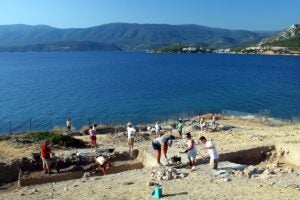
A team of Vanderbilt University students, staff, and faculty work alongside archaeological specialists to conduct a large-scale international excavation of the ancient Roman town of Kenchreai in the western Aegean Sea in Greece. Luther students will join this project in May 2026.
Six Luther students will join Davis for the four-week summer program. These students will work alongside 50 college students from six U.S. colleges and universities. They will have the unique opportunity to practice using state-of-the-art technologies in a program that combines intensive exploration on both land and sea. The summer program runs from May 22 to June 21.
“The classroom is good at building knowledge, but it cannot teach hands-on problem-solving,” Davis said. “There is a moment on every project where a student faces a problem and they have to figure out a solution. That’s when you see the students realize what they are capable of. That is the part I love most about taking students into the field.”
The Kenchreai Coastal and Marine Survey is a three-year archaeological campaign of the ancient harbor of Kenchreai, located near the ruins of Corinth in Greece. Davis will serve as underwater field director alongside project director Joseph Rife, associate professor of classical and Mediterranean studies at Vanderbilt University in Nashville, Tennessee.
“At its heart, the Kenchreai Coastal and Marine Survey is exploring a lost Roman harbor town that is now sitting underwater,” Davis said. “Whole buildings, moles and all the infrastructure of a functioning Roman port have been sitting beneath the surface for centuries. We believe there is quite a lot down there that has never been explored or documented.”
The Luther students joining the expedition on land are Zoey Evans ’27, Kira McCracken ’28, Katelyn Wilson ’28, Lauren Conner-Dieter ’26 and Louis Breimhurst ’27. In the field, they will gain experience in excavation, survey, artifact documentation and analysis, drone operation and geographic information systems. Benson Newhouse ’27 will join the team for the underwater fieldwork. Some of the students will earn credit through Luther’s Experiential Learning requirement during their four weeks in Greece.
Conner-Dieter, of Madison, Wisconsin, is excited to gain field experience this summer.
“I hope to learn how large-scale excavations take place and use the skills I learned from Luther’s anthropology program in actuality,” she said. “I am majoring in anthropology with an interest in archaeology, while also having academic interest in classical studies. This project includes both of these topics. I have not had as much field experience as I would have liked in archaeological excavations and this will provide me with a great start to my career.”
The underwater team will use a combination of underwater photogrammetry, sonar and magnetometry to map the site before excavation begins. An autonomous underwater vehicle will conduct a full survey of the harbor, with students trained in mission planning and data analysis.
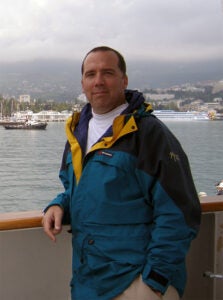
Luther College Professor Dan Davis stands aboard the research ship Endeavor in the Black Sea on Oct. 18, 2012. Davis will serve as an underwater field director for a three-year archaeological campaign in Greece starting in May 2026.
On land, the team will use a light detection and ranging drone and ground-penetrating radar to locate and capture accurate data on buried structures without disturbing the ground. The collected data will be used to produce a 3D replica of the submerged harbor that researchers can study long after the season ends.
Kenchreai served as the eastern gateway to Corinth, one of the most powerful cities in the ancient world. Ships from Egypt, Asia Minor and Cyprus would arrive at the harbor and unload their goods into warehouses along the waterfront. Some travelers would stay in the harbor town while others walked nearly six miles inland to the city.
“The town as we know it was founded by the veteran legions of Julius Caesar. For centuries it was a wealthy, internationally connected community,” Davis said.
Around 370 A.D., a massive earthquake sent the entire harbor infrastructure straight to the seafloor in a single event. The breakwaters, warehouses, temples and public buildings all sank together.
“The structures remain well preserved and will help tell the story of this important node in the Roman empire’s vast maritime network,” Davis said. “Every time someone has looked seriously at this site, they have found something extraordinary.”
The Kenchreai Coastal and Marine Survey operates under a permit through the American School of Classical Studies at Athens. The Explorers Club, of which Davis is a fellow, has recognized it as an official Explorers Club Flag project.
Davis, a faculty member at Luther since 2011, holds the Orlando W. Qualley chair of classics and manages the classical studies minor within the history department.
Learn More
Related Posts
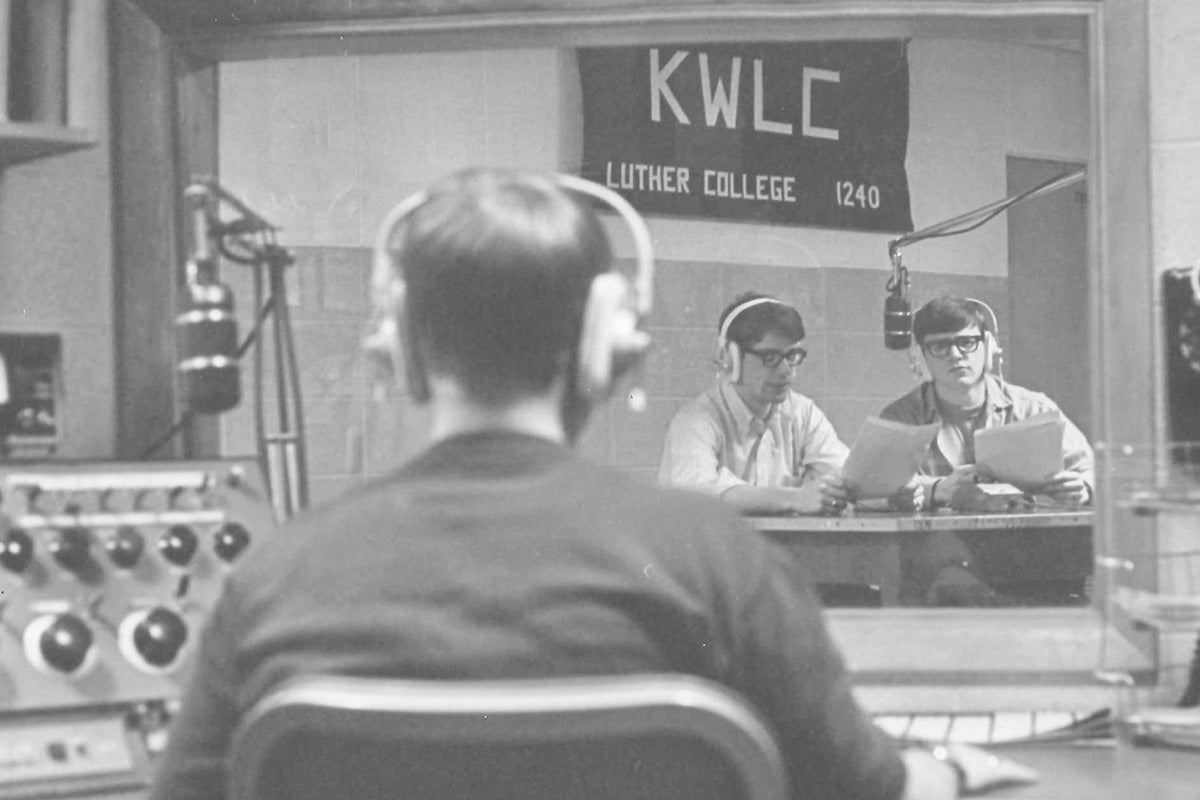
As one of the oldest operating radio stations in Iowa, KWLC serves as a professional environment for Luther students to gain broadcasting experience.
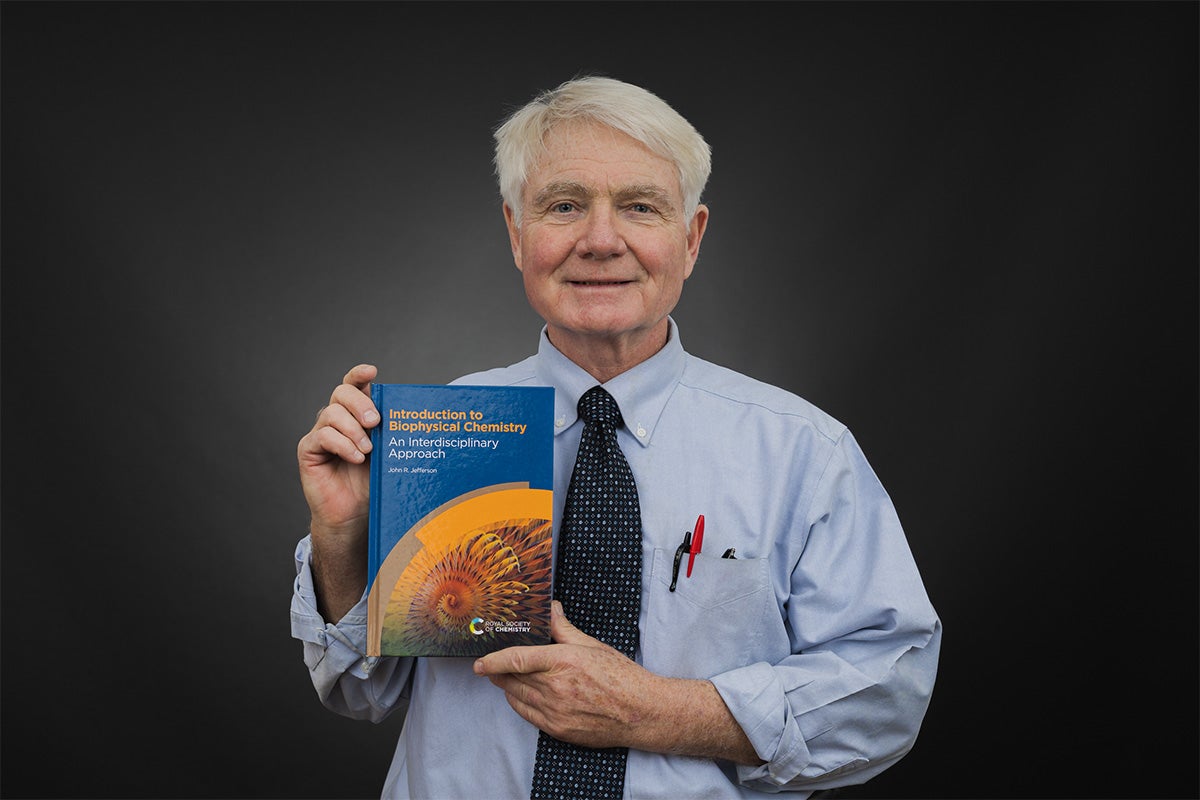
John R. Jefferson’s textbook is designed to help college students investigate some of the big unanswered questions in biology.
Contact Information
Michelle Volkmann
Media Relations Specialist
Phone: 563-387-1417