Shaped by Norwegian Immigrants
In 2025, Luther celebrated the 200th anniversary of organized Norwegian emigration to the U.S. In this issue of the magazine, we take a closer look at what it means to be a college founded by Norwegian immigrants.
Luther is the very first college founded by Norwegian immigrants in the U.S. Just 36 years after the Restauration sloop set out from Stavanger, Norway, with 52 hopeful people packed into her small belly, there was enough interest, energy, and vision among the Norwegians who settled near Decorah to found the big, enduring project of Luther College.
In Sagas of Luther College, David Faldet ’79, professor emeritus of English, writes, “Luther College exists because emigrant Norwegians wanted their children to become educated leaders. Even if these children had never smelt the lichen-hung forests of Norway and never climbed the mountains on which those forests grew, they would know the language, the literature, and the culture of the place whose memory their fathers and mothers carried tenderly in their hearts.”
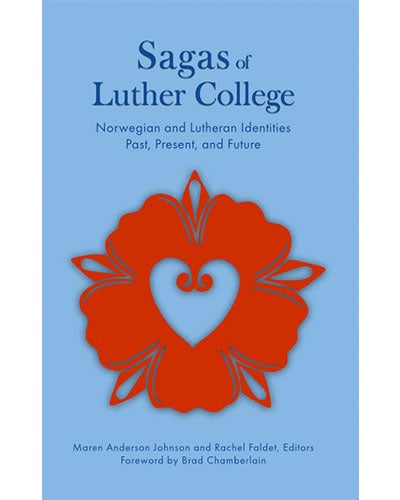
To learn more about the college’s Norwegian Lutheran history and identity, check out Sagas of Luther College, a collection of essays and reflections by members of the Luther community. It’s available in the Luther Book Shop.
But what does it mean to be a college founded by Norwegian immigrants? What does it mean for our diverse campus community—the majority of whom no longer come from a Norwegian or Lutheran background—to live and learn at a college that continues to be shaped by this history?
Values We Carry Forward
Maren Johnson, director of Luther’s Nordic studies program, says that education was vital to Norwegian immigrants: “They saw education as a way to help preserve language, tradition, and religion and also as an important tool for social mobility and social change.”
Johnson points out three values that the Luther College of today carries forward from the Norwegian tradition of the 19th century: community, the common good, and vocation.
“Those are pillars upon which Luther was founded and that we continue to explore not just in the Nordic studies program,” she says. “Those values encompass every academic discipline, every music ensemble, every athletic competition, every co-curricular project. Our students in every area are being exposed to questions about common good, vocation, and how they’re going to uplift the communities around them. Those values still shape the institution that Luther is today.”
Room for Diverse Backgrounds and Perspectives
In Sagas, President Brad Chamberlain writes, “Luther’s Norwegian Lutheran identity and heritage enable it to be historically rooted, open to all peoples and perspectives, and vibrantly fulfill its mission among changing student, faculty, and staff demographics.”
Luther was founded on a Norwegian Lutheran tradition that is open-minded and open-hearted to the world around it. According to the Evangelical Lutheran Church of America, “Faith opens a place for engaging others in conversation, for seeking the truth, for asking questions and speaking love in word and deed.” In this way, faith and learning are not adversaries. In fact, faith welcomes inquiry and exploration. It welcomes engagement with our neighbors and the world.
Johnson points out that Luther’s immigrant founders have connected the college to a global community since the college’s founding in 1861. “This commemoration has been another opportunity for us to invite students to conceive of their communities not just as local but as something much broader,” she says.
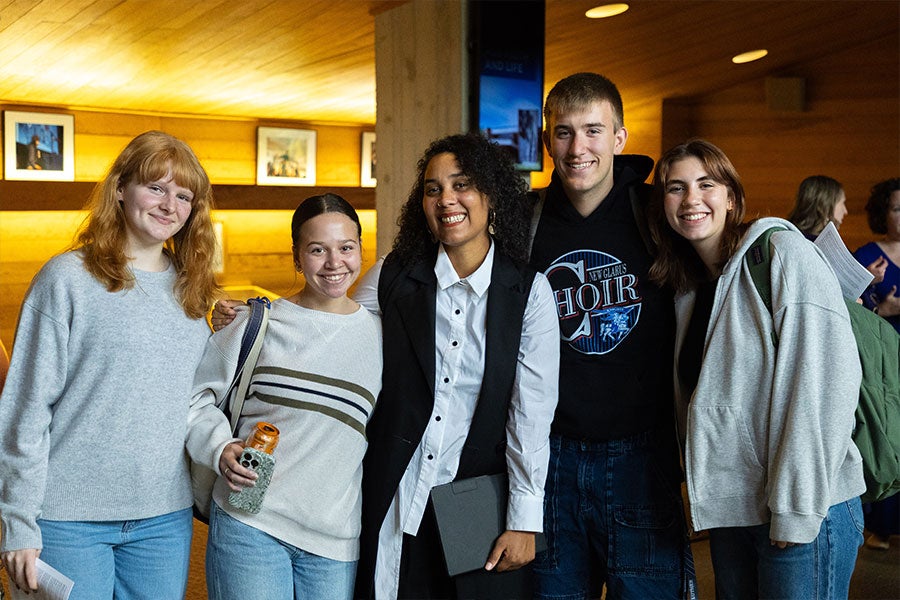
Camara Lundestad Joof (center), author of the 2025 Paideia summer read, spoke at Convocation in the fall, taking time to connect with students afterward.
We extend that invitation in part through the learning we ask students to do. This year’s Paideia summer read for first-year students was I Talk about It All the Time by Norwegian Gambian author Camara Lundestad Joof. A queer Black woman, Joof questions what it means to be Norwegian and challenges the myth of a nonracist Scandinavia. She spoke to Luther students at Convocation about the transformational power of reading about others:
“We all deserve to see ourselves as the hero of the stories we read. Our dreams stretch, they swell when we can imagine ourselves as something other, something bigger, something braver. But it is also a privilege to transform the self by approaching the world from the perspective of the unfamiliar. To celebrate the discovery of the other. If one is unable to conceive someone else—someone other than oneself—as the hero of the tale, if you are unable to envision something completely apart from you as the focal point of a story, it is a crime against your imagination. Then the uniformity of narratives you have been given has stolen something from you.”
The founders of Luther College did imagine “something other, something bigger, something braver.” They also lived in a tradition that valued encountering the world in a spirit of inquiry, cultural and global exchange, social justice, and uplifting the common good. We are lucky to inherit this legacy, and how we engage in the world will be the measure of how well we uphold it.