Growing Together
Collin Kern ’20, development coordinator with the Institute for Agriculture and Trade Policy (IATP), says, “We need food that people can actually eat, that people can make a living producing, that is going to be available and supportive of the places it’s being grown in.”
Elyssa Eull ’16 has been growing food for over four years at California Street Farm. She farms with her sister, Cory Eull ’21, on the one-third-acre farm in the middle of Minneapolis’ arts district, surrounded by a park, a giant rabbit sculpture, art studios and galleries, and railroad tracks. Produce from the farm is sold at their weekly farm stand, at farmers markets, to CSA customers, and to local restaurants and nonprofits. “Every element of our business is reliant on the fact that our community is supportive of us being there,” Elyssa says.
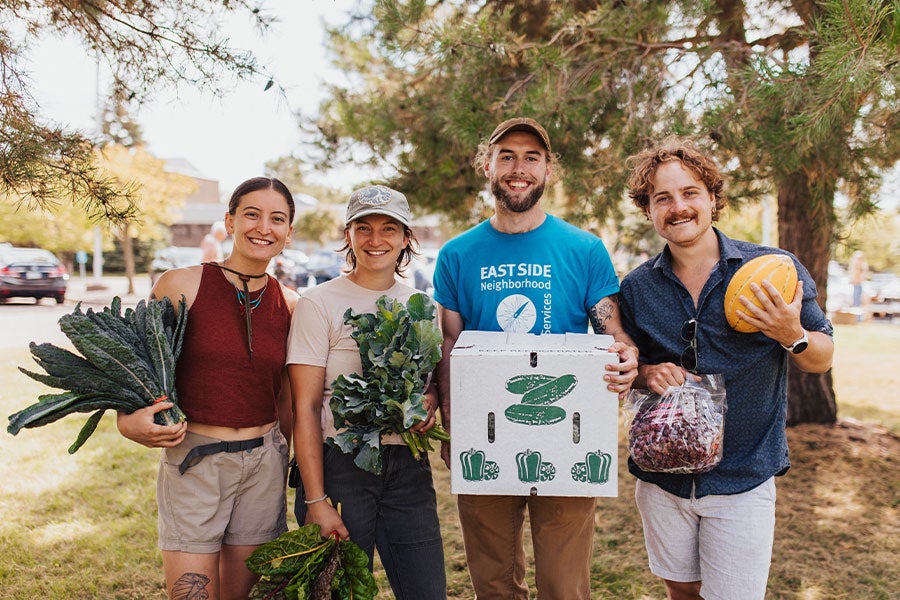
Luther alumni who work in different areas of food access and food systems collaborated at an event last fall that distributed produce to 115 households in northeastern Minneapolis. From left: Cory Eull ’21, Elyssa Eull ’16, John Mai ’19, and Collin Kern ’20. Photo by Hunter Meyer ’22.
California Street Farm accepts EBT at their Monday night farm stand. “That feels like a really important piece of doing this work: making sure it’s accessible to everybody,” Elyssa says.
Just down the street from California Street Farm, John Mai ’19 works hands-on with food insecurity as a program coordinator at East Side Neighborhood Services (ESNS).
“I really love our program, and I really love the people we serve,” John explains. “We’re able to increase access to food in a unique way. We remove barriers like transportation, we focus on language and cultural barriers. Our services are provided at no cost to our participants.” ESNS distributes food to thousands of clients annually through a combination of walk-ins, deliveries, and pop-up produce distributions. In 2024, ESNS distributed more than one million pounds of food.
ESNS holds monthly produce distributions at up to five different sites during the summer and early fall. This September, the work of all four Luther alumni—John, Collin, Elyssa, and Cory—intersected during a produce distribution at ESNS’s main campus in northeast Minneapolis. The northeast produce distribution is located next to a high-traffic pedestrian trail, where runners, bikers, and walkers pass by from sunup to sundown.
“With the COVID era, there was definitely an influx in funds to support food and healthy eating and culturally familiar foods,” says Carolina Elizondo, director of food programs at ESNS. These funds, in part, have made these community distributions possible, keeping accessibility at the forefront. There are no income restrictions, and there is no collection of names or addresses.
For September’s event, ESNS purchased produce from Elyssa’s California Street Farm. Locally grown produce adds value to the community, Carolina believes. “We’re able to provide quality and variety and we’re able to support the local food economy while doing it. So it’s definitely a win-win there.”
Elyssa credits California Street Farm with “providing a super high-quality product” that is “grown fresh and is driven a maximum of five miles away.” For the September event, it had to travel only a few blocks from where it was grown.
To help distribute food at the September event, Collin brought IATP’s staff. They unloaded and organized thousands of pounds of produce and handed it out to a total of 115 households.
Policy work is “not very tangible all the time,” Collin states. “[Volunteering] helps us reconnect to what we’re actually working on.”
Collin dreams of a world where individual growers and consumers, rather than corporations, dictate food systems. But getting there isn’t easy.
Resources like land, capital, and equipment are traditionally available to large-scale, generational farmers. Elyssa believes that urban farms like hers would be more common if land were more accessible. She believes that land trusts, public funds, and cooperative ownership could create avenues for small, profitable farms to serve their urban communities.
Ben Lilliston, IATP’s director of rural strategies and climate change, admires California Street Farm’s work, saying that it’s “an example of how productive you can be on such a small piece of land. The amount of food that they produce is really inspiring.” He agrees that increased access to markets, to physical land, and to technical support would make urban farming more feasible for young people.
IATP has a realistic outlook about how quickly these goals can be actualized. “The winds are against us in Congress,” Ben states, “but pushing as hard as you possibly can in this kind of situation lays the groundwork for when there is more of an opportunity and support within Congress to make these changes.”
Collective action—like the kind that’s happening among northeast Minneapolis Luther alumni—is the key to creating sustainable change. Food production, direct service, and advocacy all have a role to play. “It’s not just one single thing,” Ben concludes. “But you have to sort of think about them together because it is a food system.”