Art Inspiring Action
The lights dim inside Zion Lutheran Church in Anoka, Minn., and the audience murmurs itself into silence. One person after another steps onto the stage, each telling a story of the slow build of abuse and the impossible calculus of leaving. The stories braid together, mixed with vocal solos and a dance between a husband and wife while “What’s the Use of Wonderin’?” from Carousel plays. It’s an infamous song, the one everyone hates, the one where the abused woman sings, He’s your fella and you love him and all the rest is talk.
The show is called Flight. It centers on domestic violence, and you can feel the weight of it in the room. But when the applause fades, the audience doesn’t carry that weight home alone. They’re invited to stay—to talk with the actors, with each other, with representatives from The Dwelling Place and Anoka County Violence Prevention Roundtable, offering information and ways to help.
It’s not your typical night at the theatre. It’s a performance that asks something of you.
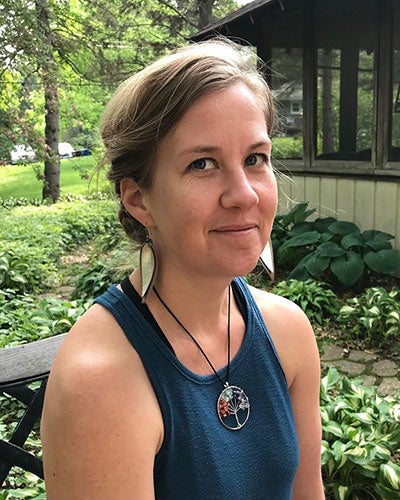
Katie (Anderson) Fischer ’01
This is the seventh season of Twin Cities-based nonprofit The Art of Reconciliation, founded and led by executive and artistic director Katie (Anderson) Fischer ’01. It gets at something Katie has been reaching toward her whole career: the moment after the curtain falls, when an audience is moved but doesn’t know what to do with it.
“I find that so often shows bring up a lot of really good points, a lot of really hard topics,” Katie says. “And then you walk out and you’re like, Now what?”
Every production is built around that question. Each show pairs a performance with an education component, bringing in professionals working on the highlighted issue, then closes with a partner organization offering real ways people can help. The audience leaves with somewhere to put what they’re feeling.
Fischer is quick to explain the instinct behind it.
“When something really horrible happens to a family, I’m coming over with food,” she says. “That’s part of my makeup. Instead of just sitting in the hurt and sorrow, it’s like, Well, what can we do? We can make a hot dish.”
The Art of Reconciliation began in 2019 with the question: What if a production of Jane Eyre could connect audiences to the work of healing childhood trauma? When Jane Eyre reached the stage in 2021—rehearsed, in the early days, in Katie’s driveway—the response was strong enough that she incorporated as a 501(c)(3) the following year. Since then, the company has worked with over 150 creative collaborators, supported eight nonprofits, and brought more than 3,000 people through its doors.
The Road to Reconciliation
Getting to this work required the kind of winding path that couldn’t have been planned. A theatre/dance major at Luther, Katie found herself in a department that was unusually rich. She trained under radically different approaches: ballet, modern, jazz, Capoeira, somatic movement fundamentals.
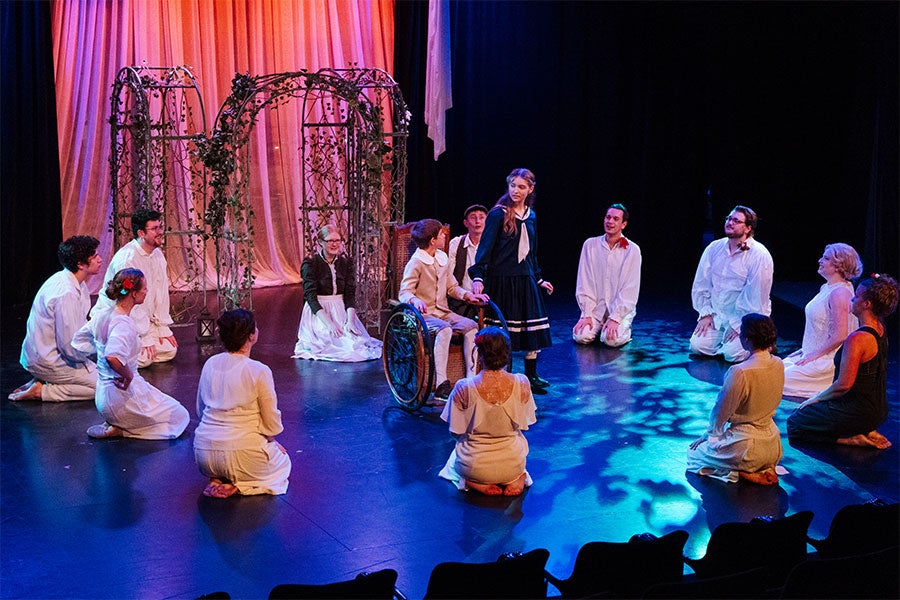
Katie's theatre company staged a production of The Secret Garden, partnering with St. Paul–based Urban Roots, which empowers youth through nature and healthy food.
The summer before her senior year, she planned to spend time in New York. Instead, she went out for a bike ride and woke up in a hospital. Found unconscious by three middle schoolers who applied pressure to her head wound until help arrived, she spent months recovering, the somatic techniques she learned at Luther shaping her healing and her next move.
She found a California training program called Moving On Center, and went west to join it. What she encountered reoriented something foundational.
“I was there when 9/11 happened,” Fischer recalls. “It shifted my mentality from I’m performing to be seen to This can be a powerful influence in the world.”
She returned home to Minnesota, started working in movement therapy and children’s ministry, and spent 15 years choreographing, always circling back to the same question: What do audiences do with what they feel after the curtain falls?
It’s the question from which The Art of Reconciliation emerged. Each production has partnered with a different organization—among them The Secret Garden with Urban Roots, which empowers St. Paul youth through nature and healthy food. This summer brings a full production of Rodgers and Hammerstein’s Carousel—eight performances, with a resource fair reflecting the show’s central theme: breaking generational cycles of abuse.
None of this is lucrative. Katie is candid about the financial reality. Ticket prices are on a sliding scale by design, stipends are modest, and the arts are perpetually underfunded. But the community she’s built is something Katie talks about with unmistakable warmth. Actors return. Audiences come back. Organizations keep partnering.
“Creating space for people to come together, to be present, to put your phones away and value live performance,” Katie says. “To me this is so satisfying and so much different than watching quick entertainment on TV.”
In the Twin Cities right now, that kind of space feels like more than art. It feels like a response.
To learn more about Katie’s work, visit theartofreconciliation.com.