A Breakthrough
The research that Jorge Chavez ’20 did as Luther student with biology professors Eric Baack and Jodi Enos-Berlage was high-impact. “Working with them made me realize that I really like microbiology, especially in a public health setting,” he says. “And when I went to grad school, I was already ahead of the curve in looking for lab positions because of that experience.”
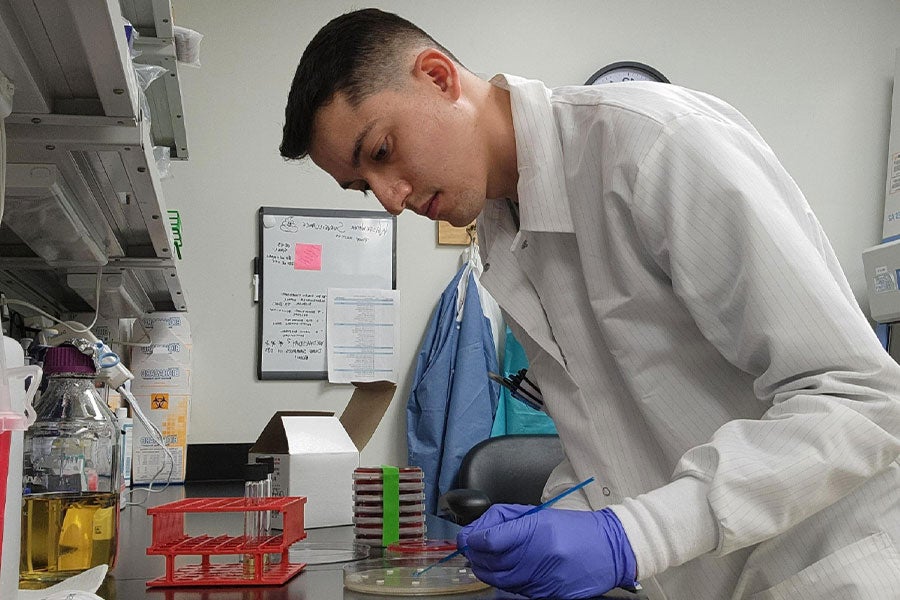
Jorge Chavez '20 works as a biologist in the CDC’s Clinical Environmental Microbiology Branch.
A J-Term about sustainability in the Southwest had piqued Jorge’s interest in Colorado, so after Luther, he attended Colorado State’s renowned master’s program in microbiology. His resume got him into not one but two labs, which no one else in his program was doing.
He quickly found himself in an epicenter of public health during a worldwide public health crisis: one of his labs was testing for COVID through saliva samples, the other was testing for it through wastewater samples. “Because I already knew water sampling techniques and methodologies from working with Dr. Baack, they pretty much instantly hired me,” he says.
After Colorado, Jorge took a fellowship funded through the CDC at the Utah Public Health Laboratory, where he accomplished a worldwide “first” when he was able to cultivate a yeast pathogen called Candida auris in wastewater. C. auris has high mortality rates, it’s hard to get rid of, and it’s increasingly prevalent in clinical settings like hospitals. Knowing that it can survive in wastewater gives scientists a new way to monitor its levels. At the time of Jorge’s discovery, no one knew if the pathogen could be recovered in a wastewater environment.
When he identified C. auris, Jorge experienced a true eureka moment. “I remember telling my supervisor that I found it growing. He literally jumped up in joy and started running around the whole lab telling people that we finally did it,” Jorge says.
Jorge’s breakthrough opened up the field—and got the attention of the CDC, his dream employer. He moved into a CDC mycotic research fellowship, where, he says, “I was working with molds inside of soil, which I actually also learned how to do at Luther and was able to develop the protocols for that lab because of what I did at Luther.” Then he moved into his current position as a biologist in the CDC’s Clinical Environmental Microbiology Branch, where he specializes in wastewater surveillance of biofilms, particularly looking for multidrug-resistant organisms.
Alongside this work, Jorge continues to present to labs around the world, offering guidance on C. auris surveillance. He also keeps up a rigorous publication schedule—seven papers so far—and the international community notices when he puts out new work.
His latest paper looks at whether seasonal changes affect how we understand wastewater data and whether certain pathogenic organisms survive or grow better in wastewater at different times of the year.
As multidrug-resistant organisms become a bigger threat to human health, these are the kinds of discoveries—and Jorge is the kind of researcher—that will lead the way forward in an increasingly important field.