Clayton and Goble receive Kuh and Krahn Family Awards
Two Luther College students, Jaydan Clayton ’27 and Ellie Goble ’28, are being recognized for their positive influence on campus culture.
Clayton received the 2026 Kuh Family “Positively Luther” Award. Goble received the 2026 Krahn Family Student Life Service Award. The students were selected based on their character, leadership and participation in campus activities that contributed to the quality of campus life.
Kuh Family “Positively Luther” Award
The Kuh Family “Positively Luther” Award was established in 2015 by George Kuh ’68, regent emeritus, Warren Kuh ’74 and Kristian Kuh ’97. This award is presented annually to a student whose character, leadership and participation in co-curricular and other educationally purposeful activities enhance the quality of campus life.
Jaydan Clayton of Evansville, Indiana, is the 2026 award recipient. She is a law and values and political science double major with a minor in sociology.
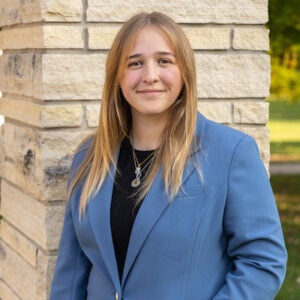
Jaydan Clayton
Clayton has been involved in several areas of campus life during her time at Luther. She was a member of the softball team for three years. She served on the Student Senate for two years as the Gender and Sexuality Diversity Representative and vice president. Clayton worked as a resident assistant for two years in Dieseth Hall and the College Apartments.
Dean of Students Julie Thornton encouraged Clayton to apply for the award.
“As the Student Senate advisor, I encouraged our exec board to explore the Kuh award criteria and pitch project ideas to enhance the Luther community,” Thornton said. “I wasn’t at all surprised to see Jaydan submit an application. She consistently brings a positive attitude and a strong commitment to contributing to life at Luther. I am excited to see what she accomplishes during her senior year.”
Clayton hopes to have a positive impact on Luther College by creating opportunities and access for students to reach out for help and build connections within the community.
“It feels really meaningful to be selected for this award because it will allow me to make a positive impact on students, not only at Luther but also within my major and future field of study,” Clayton said. “A Luther alum once told me, ‘90% of your success is who you know, and the other 10% is the work you put in.’ As I prepare for law school, I have been fortunate to meet and work with a long list of Luther alumni who have made my journey much easier. Now that I have been able to pave a path for myself, I want to make sure those connections and opportunities remain available to future students and future lawyers that Luther will produce.”
Krahn Family Student Life Service Award
The Krahn Family Student Life Service Award was established in 2013 by Roger A. ’68 and Laurie Krahn. Each year, one sophomore or junior student is selected through a nomination process to receive the award, which recognizes a student who has demonstrated a strong contribution to campus life in a way that embraces the spirit and mission of Luther College.
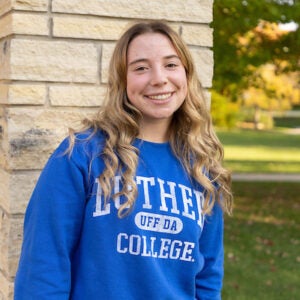
Ellie Goble
The 2026 Krahn Family Student Life Service Award recipient is Ellie Goble. Goble is a social work major from New Windsor, Illinois.
She has been involved in several areas of campus life during her time at Luther, including the entertainment co-chair and social media coordinator of the Student Activities Council. She has served as president of both the Social Work Association and Tuesday Night Discipleship. She is a Culture and Religion Representative in the Student Senate. Goble participates in Fellowship of Christian Athletes, Special Olympics, the Council for Equity and Inclusion, and Common Ground. Goble is also a resident assistant in Ylvisaker Hall.
Goble was nominated by several staff members at Luther.
“Ellie is a bright light on campus,” said Kris Franzen, director of residence life. “She seems to know just about every person on campus and they know her. She brings a positive attitude wherever she goes, and has the kind of personality that encourages people to get involved. She leads by example and is the first to volunteer when we host programs on campus. She embodies Luther’s commitment to community through her various roles on campus.”
Goble said being selected for the award is meaningful because of her commitment to building community and creating a positive experience for students at Luther.
“Being recognized for my involvement on Luther College campus means so much to me because I truly care about building community here and making a positive impact for all students. It’s an incredible feeling to know that my work with SAC, as an RA, Student Senate, SWA, and our campus activities has made a difference. At the end of the day, my goal in everything I do on campus has always been to share a little bit of extra joy with the people around me,” Goble said. “A special thanks to the Krahn family for making this award available to recognize students at Luther; I am extremely grateful.”
Related Posts
He was recognized for advancing the work of UMACS as an organization and supporting sustainability across the region.
“Luther College is thrilled to welcome Seraph Brass, an all-woman quintet of horn, two trumpets, trombone, and tuba, which tours throughout the world,” said Susan Potvin, director of programming and outreach.
Contact Information
Michelle Volkmann
Media Relations Specialist
Phone: 563-387-1417