Day in the Life of a Biology Major
You’re looking for your future major—but let’s be honest, you don’t know what half of them actually entail. This series fills you in on what these majors mean at a liberal arts college, so you can decide for yourself what’s most interesting to you. Here’s what a biology major looks like from the perspective of an actual student.
Biology is the study of life, and that can actually mean so many different things. Studying biology can look like learning about different kinds of plants and animals, your cells and metabolic processes, how different species have evolved over time, and so much more. Cato chose to be a biology major at Luther College because she has always been interested in nature, and would like to pursue its study for a professional career. POV: You’re a biology major.
7 a.m. Ready for Reading
My day starts just an hour before my first class of the day, Chemical Principles. I like that this class teaches me about the tiny little particles that make up the world, although sometimes I’d rather sleep in.
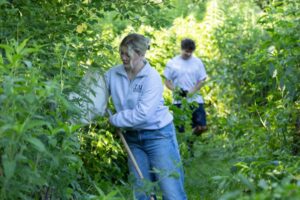
Finding your own path of interest in biology opens up doors for what’s next.
But after class I wake up with coffee from Nordic Brew and study in the Valders pit — a study lounge in the science building.
Going into the biology major, I thought everyone would be taking a relatively similar path. Instead, the people I’ve met are interested in all sorts of careers. I know people who want to be doctors, ecologists, microbiologists, and zoologists. Being around people who focus on different facets of biology has broadened my outlook and encouraged me to try new things.
The most important skill I’ve learned that will transfer to my future career has been how to write a lab report. Since I want to focus on environmental research during my career, knowing how to write an effective paper is essential.
12 p.m. Lunch and Class
Then I’ll leave Valders to meet up with friends for lunch. We do homework, yak, and eat, and it’s a great way to relax before more classes.
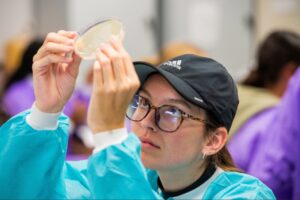
Applying info from lecture to lab is the fun part!
A typical biology class has two sections: lecture and lab. Lectures are usually an hour long and meet three times per week, and that’s where your professor teaches you the core concepts of the course topic. Then in the lab, which usually meets once a week for two hours, we focus on applying that information to real situations.
This semester, I am taking three classes along with music lessons (which give me one class credit). This is a little less than my typical courseload, but the courses I’m taking require a lot of work outside of class. It’s important to take into consideration what you can handle, and this semester, that’s what works best for me! Two of my classes, Chemical Principals and Entomology, are more science-based courses, and the other, Intro to GIS, is a mix of computer software and environmental science, which is interesting.
Entomology is my favorite class this semester; I’ve gotten to learn so much about insects, and I’ve even started a collection. My friends don’t love hearing about the bugs, but they’re grateful when I catch the ones in our dorm room.
As a first year, talk to your professors about opportunities outside of class. They have great connections with others in the biology field, and they want to help you. They can write you letters of recommendation, suggest possible career avenues that align with your passions, and even refer you to jobs and internships. Building relationships with your professors is valuable.
3:45 p.m. Clarinet and Ballroom Dance
After class ends, I like to head over to the Jenson-Noble Hall of Music and practice my clarinet.
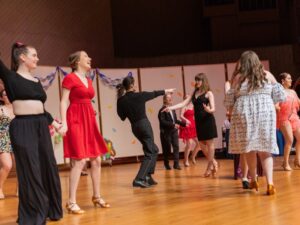
Find community in whatever groups you decide to join.
I also have weekly band rehearsals, clarinet seminars, and lessons. Sometimes it can be hard to balance practice with my homework since I’m not a music major, but I find playing really rewarding.
I’ve found a great community among my fellow band members and clarinet players, and this year I’m the co-principal clarinet. I appreciate how Luther provides opportunities for all students to engage in music.
I am also a part of Luther’s Ballroom and Swing Club, which is something I just joined. It’s been really fun to learn dances with my friends and meet new people.
6 p.m.: Study Study Study
Sometimes biology courses can be a lot of memorization, but the application of the knowledge is the most important part.
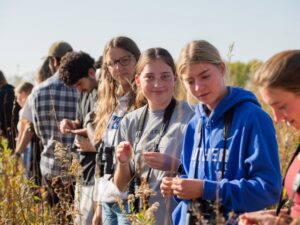
It’s important to engage in what you’re learning to truly understand.
When I study, my favorite way is active recall. I check out a study room in the library or find an empty classroom, and I write down everything I know about the topic I’m studying. Then I’ll look back at my lecture notes, slides, and textbook to identify gaps in my knowledge. This tells me what I need to review. I do this usually two to five times before I’ve got it down.
The majority of my assignments vary based on the class, but lab reports and research are always required. I often have assigned textbook readings and questions to answer.
I haven’t had too much difficulty balancing my general and major-specific classes, but it’s definitely something I need to think about every time I register for classes. The hardest part for me is taking courses to fulfill college requirements that are outside of my element. I do think it’s really important, even if it’s hard. It’s valuable to not only spend time learning about different subjects, but also to engage with people with different interests and viewpoints.
Saturday: Relax and Reset
Something many college students can relate to is that it can be tough to balance school, a social life, and a personal life. Something I do to prevent burnout is to make a plan to finish my assignments Sunday through Friday, and give myself one day out of the week where I don’t do any homework or studying — Saturdays. Having this day not only allows me to refresh myself by hanging out with friends, being outdoors, and taking care of myself, but it also motivates me to work harder during the rest of the week so that I don’t have assignments piling up.
The most rewarding part of being a biology major is going out into nature and understanding how it works. If you point out a tree on campus, I can identify it. If you hear crickets, I can tell you how and why they’re communicating. Being in touch with nature is a powerful feeling.
Thank you for following Cato’s day-in-the-life! Being a biology major is hard work!
More Information About Majors
Related Posts
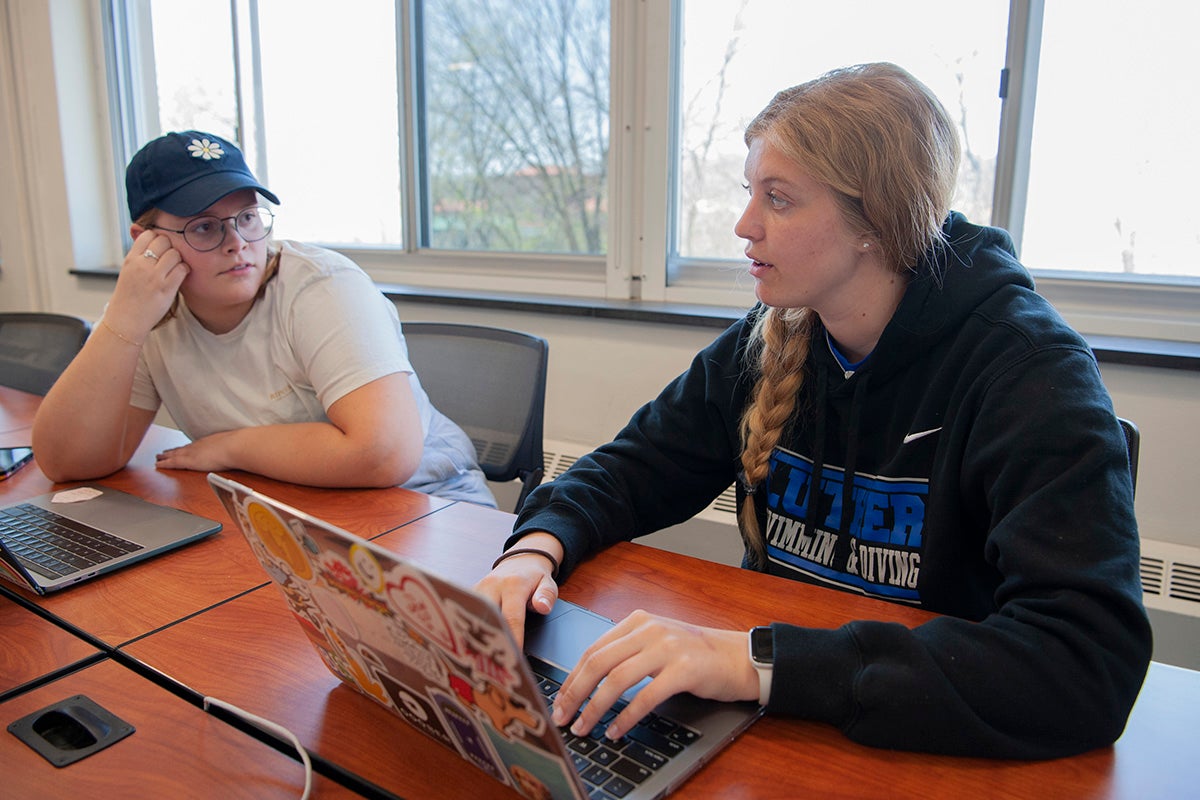
You’re looking for your future major—but let’s be honest, you don’t know what half of them actually entail. This series fills you in on what these majors mean at a liberal arts college, so you can decide for yourself what’s most interesting to you. Here’s what an English major looks like from the perspective of an actual student.
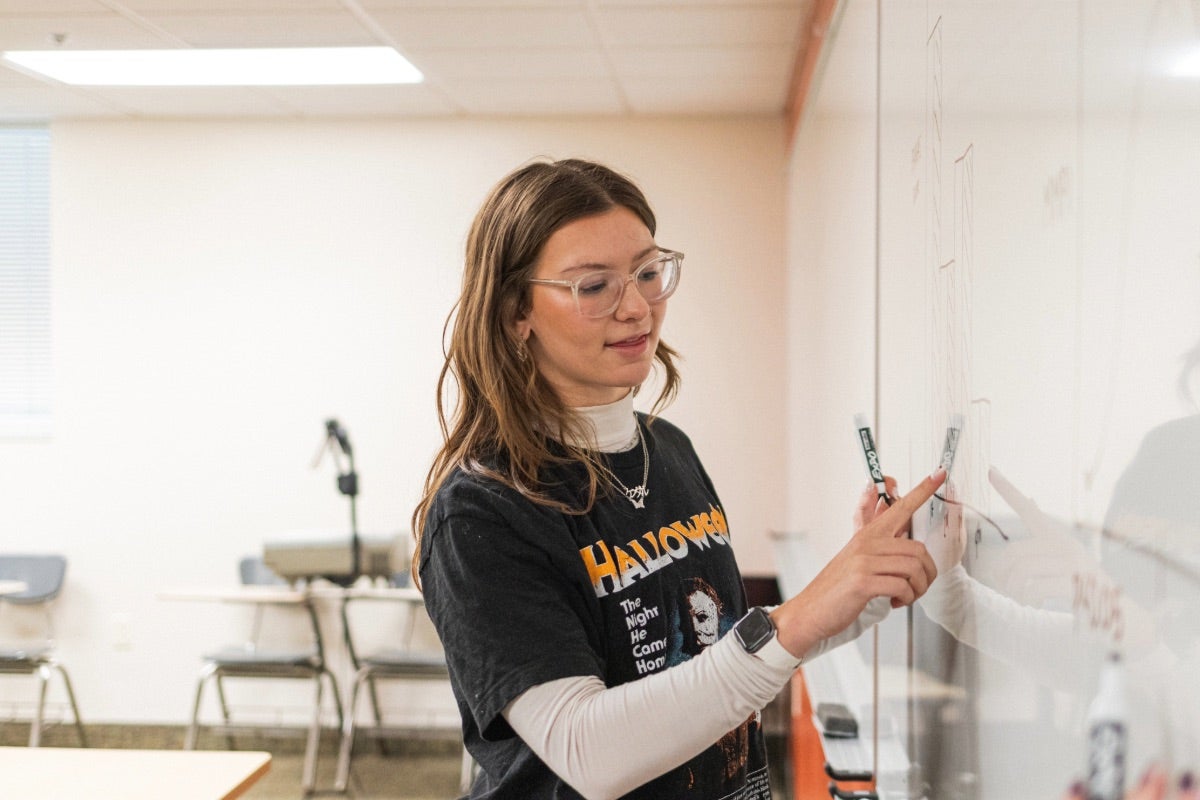
You’re looking for your future major—but let’s be honest, you don’t know what half of them actually entail. Here’s what a psychology major looks like from the perspective of an actual student.
Admissions Office
Luther College
700 College Drive
Decorah, Iowa 52101
Phone: 563-387-1287