Senior Spotlights 2026
Portraits by Armando Jenkins-Vazquez ’21
For video features on some of these students and others, visit our Senior Spotlights playlist on YouTube.
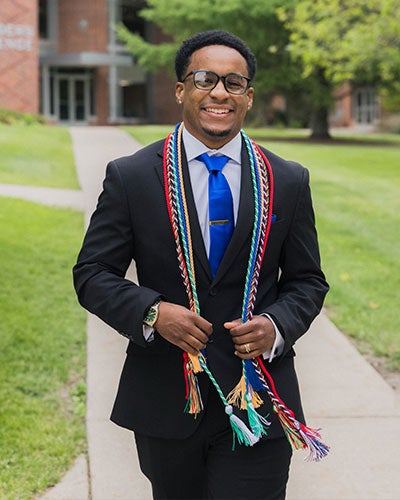
A Social Work Major with a Positive Ripple Effect
Growing up in Atlanta, Georgia, Malachi McElroy was a kid who loved people, school, and football—maybe in that order. When Luther coaches started to recruit him, he and his parents visited campus and quickly fell in love. “From the moment I arrived, there was a sense that people genuinely cared about one another. I ultimately chose to attend because my mom loved Luther so much it was honestly a bit of a non-negotiable,” he laughs.
As a first-generation college student who’d always done well in school, Malachi initially struggled to adjust to new expectations in a new environment, fresh out of the pandemic. “It was a shock culturally, emotionally, and physically,” he says. He credits sociology professor Char Kunkel with pulling him out of the hole. “She gave me the courage and wisdom to navigate one of the hardest periods of my life,” he says. “She taught me to advocate for myself and propel myself to the next level.”
On Professor Kunkel’s advice, Malachi connected with resources like TRIO, a program that specifically supports first-gen, income-eligible, and other students. After that, he was like a bird taking flight. “When I started to find resources, I thought, Luther has given to me. I need to give back to Luther. So I started to get involved with everything,” he says.
Malachi made a mark as an Admissions ambassador and as a member of Student Senate, the Student-Athlete Advisory Committee (SAAC), the Athletic DEI Committee, and the Black Student Union. He studied off campus in Costa Rica. He interned at Easterseals Iowa and, through the Washington Semester, at Capital Hill Consortium for Counseling and Consultation in D.C.
“My time at Luther has been such a roller coaster of an experience, but I would not have traded it for the world,” he says. “One of the things that makes me feel good about whatever legacy I’m leaving is how many athletes within the football program are involved in different things compared to my freshman year. I can point to an abundance of students who are Admissions ambassadors, who are in TRIO, who are tutors, who are on Student Senate or SAAC, who are involved in multiple student orgs because I advocated for that.”
This fall, Malachi started a graduate program in social work at Albany State University. He’s aware that the percentage of Black male social workers in the U.S. is astonishingly low, and he hopes to be a resource for people who need him, saying, “I just want to go where I can have the most impact and really change lives.”
—Kate Frentzel
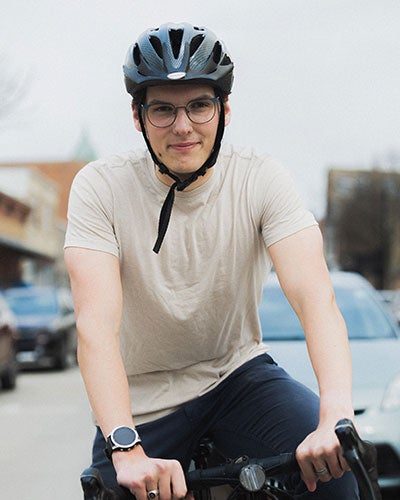
A Future Engineer with Diverse Campus Involvement
A graduate of the Minnesota Boychoir and of his high school band, Kieran Ulbee moved headlong from the Minneapolis music scene into Luther’s. In Nordic Choir for three years and Concert Band for four, he’s been on six domestic tours. “They’ve allowed me to travel all over the U.S. and perform in spaces such as little churches in Arkansas, where we outnumber the people watching us, or for the American Choral Directors Association in Texas two years ago for an audience of thousands,” Kieran says. His ensembles have also toured in Norway and Japan.
As co-president of Luther Bike Council, Kieran managed the annual Decoride bike fundraiser, which supports regional nonprofits. Through that organization, he also secured more bike storage and other other improvements for bicyclists on campus.
When the engineering science major was announced his sophomore year, it was an easy decision for Kieran to switch over from physics. Last spring, he and his two fellow seniors in the major—the first three students to graduate with engineering science majors—completed an impressive senior project together by designing and 3-D printing an electrostatic fog collector. Traditional fog collectors, which can be used in desert and coastal areas to create clean water, use mesh or net to collect fog, which then drains down when drops get big enough. Kieran’s model improved efficiency by using a high-voltage wire to create forces to suck water to the mesh. “I’m a big proponent of clean energy and renewable resources, so it’s been really valuable to see how I can apply my engineering to green energy and issues like water shortages,” he says.
During his time at Luther, Kieran worked in the cafeteria for three years, as a physics tutor, and at Toppling Goliath, in its quality control lab—and he still managed to graduate cum laude. This fall, he started a dual degree program at the University of Colorado Boulder in engineering management and electrical engineering, with a focus in next generation power and energy systems.
—Kate Frentzel
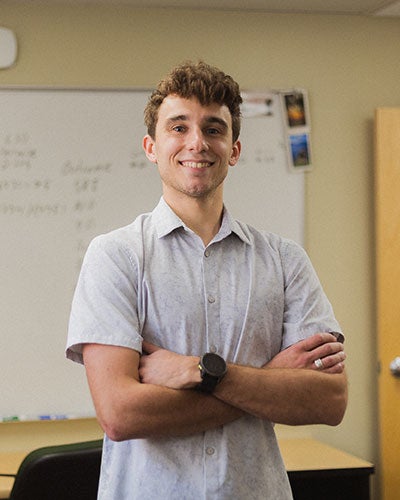
A Sophisticated Researcher Helping Others Flourish
Harrison Arnold, a neuroscience major from Marion, Iowa, has long been drawn to the field. “There’s still so much unexplored territory in it,” he says. “Every neuroscientist is a pioneer, to a degree.”
He was interested in Luther because of its growing neuroscience program and high matriculation rates into medical school. An avid mountain and now gravel biker, he was also thrilled about Decorah’s trails. During his time in Decorah, he became close riding buddies with biology professor Mark Eichinger and psychology professor Joe Breitenstein.
As student director of professor Loren Toussaint’s Forgiveness Lab, Harrison pioneered what Toussaint calls “one of the most sophisticated and insightful
studies of stress and relaxation in the history of my lab.” Harrison’s study gathered physiological data related to different meditation techniques and then connected that data to psychometric measures, like levels of forgiveness and excitement.
“The study fit an interest of mine—the brain, its mechanisms and connections and connectivity—but it also gave me the ability to do work that’s meaningful and impactful at an immediate level,” Harrison says. “In the end, I gained more questions than answers, which is completely fine—it just means I have more to learn.”
Harrison will continue that learning as a medical student this fall at Washington University in St. Louis, consistently ranked as a top-ten medical school with one of the largest research budgets in the country. Harrison chose it in part because its professors felt as readily available as Luther’s. “I really wanted to transition to a place that had the kind of connectivity between students and faculty that we have at Luther,” he says.
A highlight of Harrison’s time as director of the Forgiveness Lab was supporting other students as they journeyed from newbie to experienced researcher. Similarly, he says he ultimately wants to “find a role that allows me to watch patients flourish while also being in that position to facilitate growth. I want a practice that allows me to have direct patient care, longitudinal relationships, and the ability to apply my expertise in an ongoing situation.”
—Kate Frentzel
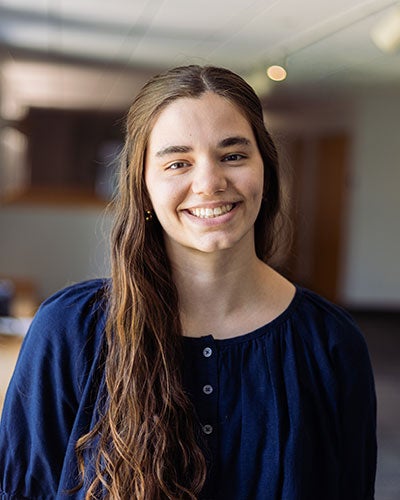
Bound for Law School, Centering Kindness
Anna Tauscher remembers visiting Luther as a high school student from Rochester, Minn. When her tour guide’s key didn’t unlock the residence hall showroom, a random student offered to let the group into her room. Anna thought, These are the kind of people who come to Luther. It swung her college decision and underpinned her decision to work as an Admissions ambassador during her four years at Luther.
A political science and economics double major, Anna had no background in mock trial when she joined Luther’s team as a first-year. By senior year, she was co-captain. She also won an Outstanding Attorney Award at an American Mock Trial Association (AMTA) invitational. She’s proud that the Luther team has nearly doubled since she started, and she feels that the camaraderie has grown. In the spring, her team won an honorable mention for the Spirit of AMTA Award. “Being the captain of a team that’s singled out for encouraging other people and showing kindness? There’s no better feeling than being recognized for that,” she says.
Junior year, during the Washington Semester, Anna interned at the DC Bar Foundation, a nonprofit that funds civil legal aid programs in the area. There, she worked with the team on diverse projects. It solidified her interest in law school, which she plans to start in 2027.
First, she’ll spend the next year in Minneapolis, in a fellowship through the Lutheran Volunteer Corps with an organization called the Advocates for Human Rights, in its women’s rights division.
“Being at Luther and also interning at the DC Bar Foundation, seeing the impact that you can have on the lives of people, is what really drew me to the Lutheran Volunteer Corps,” Anna says.
“This work is really impactful and worth doing,” she says. “I’m at a point in my life where that’s what’s next for me. I’ve been at Luther learning about all the problems in the world and about so much that needs to be done. Now I’m going to go do it.”
—Kate Frentzel
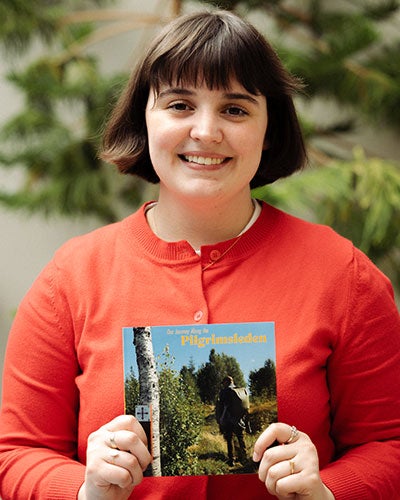
Strong Career Prep for a Vis-Comm Major
Thea Bentley of River Falls, Wisconsin, knew that she would spend her college years at Luther long before she ever took an official campus visit.
The daughter of Serina (Norvold) Hallquist ’94 and David Hallquist ’81, Thea got to know campus intimately as a child while participating in Lutherlag, an annual family summer camp then held at the college. “We never missed a Lutherlag,” Thea says, “and I always really wanted to be there.”
She was equally enthusiastic about the classes she took as a student, declaring majors in Nordic studies and, a bit unexpectedly, visual communication. Her first vis-comm class—taught by Richard Merritt, professor of art—forced her to “dig deep into creative problem-solving,” an area that so fascinated her growing up that she participated in Destination Imagination for many years. Getting to display what she created at Ultra Mega Mega, a pop-up art show at semester’s end, was the icing on the cake. “It was just so cool to see my art up on the wall,” she says.
Her interest in social media marketing led Thea to focus her classes on graphic design and photography, skills she further developed through internships with Pulpit Rock Brewery and Deco Products Company in Decorah. Her many cocurricular activities—especially serving as Chips advertising manager and Student Activities Council president and concert co-chair—helped her build an even more impressive resume and portfolio. “I didn’t think that my classes and activities would overlap as much as they did, but I got to design a lot of posters, T-shirts, and logos—and had a lot of fun doing it,” she says.
Thea so enjoyed the campus setting that she sought work at another college after graduation. In July, she moved to Tacoma, Washington, to begin a position as the social media manager at Pacific Lutheran University. She says, “I owe a great deal of my preparation for this role to my time at Luther and the many experiences and opportunities I had there.”
—Sara Friedl-Putnam
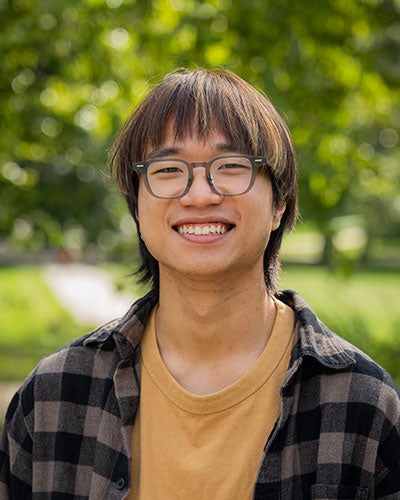
The “Wikipedia Kid” Digs into Land Stewardship
Bao Nguyen’s smile is quick, his answers thoughtful, his demeanor enthusiastic, and his quest for knowledge both fearless and seemingly endless.
“I was known as the ‘Wikipedia kid’ in my hometown because I have always loved to read and learn more about the world around me,” he says.
His diligent curiosity earned him a scholarship to an international boarding high school in Hanoi, Vietnam, about a 12-hour train ride from his hometown, Quang Tri. While researching colleges, he connected with Tai Nguyen ’24, an alumnus of the boarding school who was then attending Luther, and decided to take a closer look at both Luther and Decorah.
“I knew I wanted a liberal arts education because I’m interested in so many things,” he reflects.
Bao’s longstanding interest in global politics and international affairs led him to declare a major in international studies almost immediately. It took a bit longer to settle on his second major, environmental studies, but classes like Biology 151 (taught by professor Eric Baack, with whom he later conducted research on invasive species) helped him realize that he enjoyed the purpose-driven work of learning how to help communities become more resilient to climate change.
He chose his cocurricular activities (Chips writer, Asian Students Association and Allies president, mock trial participant), his internships (Raptor Resource Project in Decorah, Dalberg in Vietnam, and University of Nottingham in England), and his study-abroad experiences (Nottingham, England, and Oslo, Norway) with equal purpose. Bao singles out his experience in Oslo—six weeks in the summer of 2024 as a Peace Scholar—as being “everything that I could have imagined and more.”
While keeping his long-term plans open, Bao is tapping into his environmental studies major in his first post-Luther job. In June, he started work at Restore Native Plants, a nonprofit in New Jersey focused on land stewardship and ecological restoration. “A lot of the work mirrors what I did in Decorah with invasive species and land management,” he says. “It’s really cool to get further into the field of conservation and know that Luther has set me up for success here.”
—Sara Friedl-Putnam
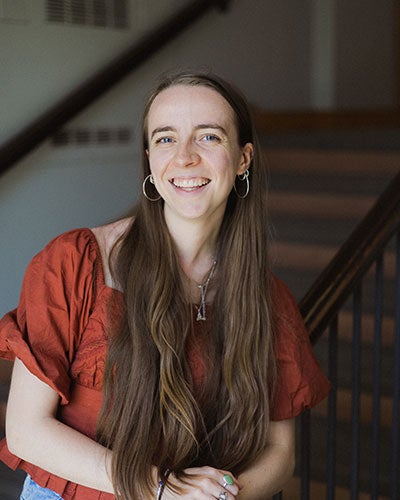
A Full Scholarship to Pursue Global Journalism
It was 3:45 on a cold March morning, and Niamh Mee understood the assignment: “I had 15 minutes to present my best self to an admissions panel in Denmark and Germany,” she says.
The time of the interview wasn’t ideal, but its result most certainly was. Niamh received emails soon after notifying her that not only had she been admitted to the Erasmus Mundus master’s program in journalism, media, and globalization but she had also received a highly competitive scholarship to cover all program expenses.
She will spend the first year of the two-year program at the University of Aarhus and the Danish School of Media and Journalism and the second at Ludwig Maximilian University in Munich, Germany. “The degree is all about the ways that people engage with the world, with truth, and with story,” says Niamh. “It’s an excellent opportunity that keeps me on a path to either become a journalist or head back to academia.”
The program also builds on a strong foundation Niamh has laid. Growing up in St. Paul, Minnesota, she read the print newspaper with her breakfast every morning. At Luther, she declared an English major (and music and education studies minors) and served as writer and managing editor for Chips. “It was often an exercise in teamwork and tenacity, because nothing ever went quite as smoothly as we wished it would,” she says of her Chips work. (Niamh also served as president of the Performing Arts Committee and sang in campus choirs.)
Niamh’s academic writing required a healthy dose of teamwork and tenacity, too. Working closely with Amy Weldon, professor of English—and tapping into her own Irish heritage—Niamh conducted independent research on writing by Irish women. One of her papers was published in the Midwest Journal of Undergraduate Research, while another, her senior honors project, tallied 141 pages upon completion.
“It was definitely a passion project, and I did significantly more work than anybody but myself asked me to do,” Niamh says of her honors paper. “But I also learned a lot about doing academic research and constructing an argument, which will be so helpful for my master’s work.”
—Sara Friedl-Putnam
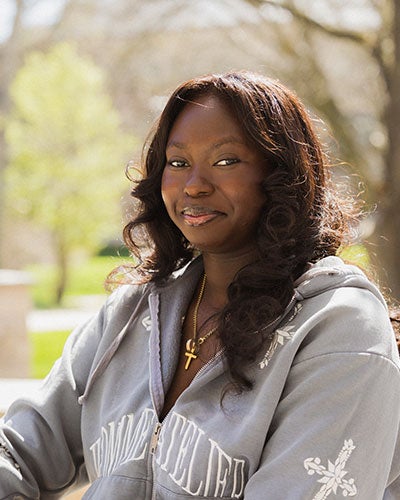
Learning How to Better Help Others
As Antonia Laker neared graduation from United World College–East Africa, she celebrated her friends’ college acceptances one after another but shared little about her own future plans.
“I didn’t want to go to college,” she says candidly. “My mother had recently died, and my plan was to go back home to Uganda and take care of my three younger brothers.”
After some prompting, Antonia finally opened up to her friends, and they pushed back—hard. “One told me that was the most ridiculous thing she had ever heard,” she says. “I’m so grateful now that she was so honest with me then.”
Attending Luther, Antonia continues, prepared her to care for her brothers—and others—in ways she never expected. “I learned how to lead, advocate for others, and build connections with people from different backgrounds and cultures,” she says. “I also confirmed that my greatest passion is helping others.”
Antonia credits her desire to pursue human-service work to her late mother, a gender specialist with the International Rescue Committee in Uganda whom she calls her “greatest role model and inspiration.” While at Luther, Antonia intentionally sought out an academic major (global health), cocurricular activities, and employment that would help her develop the skills she needed to follow in her mother’s footsteps.
On campus, she served as a resident assistant, Black Student Union activities coordinator, Beta Theta Omega president, and the Student Senate representative for race and ethnicity. Off campus, she worked at Aase Haugen Senior Services as an activities assistant and at Choice Employment as a job coach. “It was important to me to work with people who were in need or living in the margins of society,” she says of those experiences.
Antonia also spent a semester interning in D.C., through the Washington Semester, and she hopes to return to the capital city one day, perhaps for graduate school.
“I’m thinking about graduate studies in global health or epidemiology or both, because why not?” she says. “I like having a lot of different skills under my belt, and I like learning a lot.”
—Sara Friedl-Putnam