Meaningful Work
As a biology major at Luther, Ben Feldkamp ’13 was on a pre-med track but wasn’t sure it was the right fit. During an anatomy course his senior year, a guest speaker suggested testing the waters as an emergency medical technician (EMT), and this altered the course of Ben’s life.
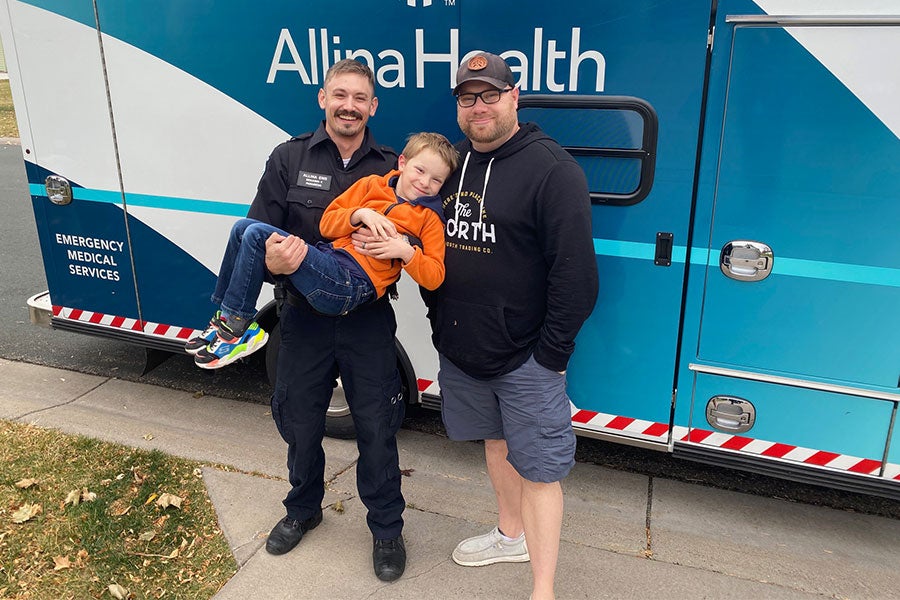
Ben Feldkamp '13 (left), who works in emergency medical services, holds his nephew during a special visit in an ambulance.
After graduating, Ben earned an EMT certification at Inver Hills Community College (Minn.), then completed its paramedic program. The field turned out to be a great match for someone with an active mind and body. Ben’s work took him to wildly diverse locations to treat wildly diverse medical events.
“The first year or two or three of being a paramedic is really about learning how to be comfortable in the uncomfortable, truly expanding your comfort zone for a good long while,” Ben says. In addition to adapting to constantly new scenarios, he says, “I also had to learn how to be the most senior medical person on call when I still felt brand-new.”
Ben learned that the role also requires inhabiting a fluctuating gray area: one day you might respond to a routine “just to be on the safe side” situation, while the next you might be the critical provider in a true emergency. “We’re kind of the overlap between public service and healthcare, and often it’s a field situation that decides which one we are that day,” Ben says. “It’s almost like learning two jobs at once.”
Over the course of his career, Ben moved from medic to preceptor, overseeing students getting on-the-job experience. “That gave me a real passion for explaining things to people and seeing them learn,” Ben says. “It really set a desire in me not only to teach but to be a great teacher.” When a faculty position opened up at Inver Hills, Ben was an easy hire.
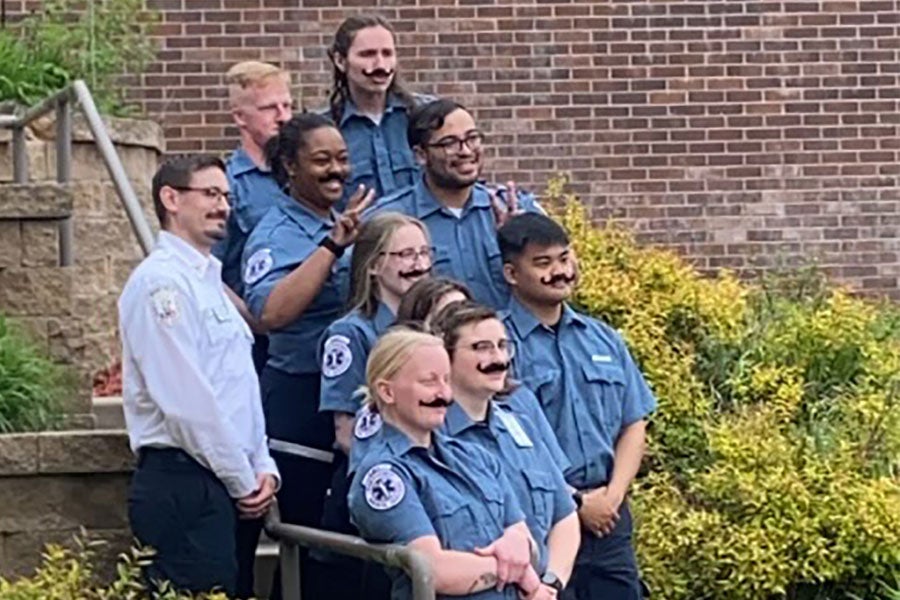
Ben Feldkamp ’13 (far left) with paramedic students from the class of 2024, who donned false mustaches in his honor.
While Ben still works several emergency medical services (EMS) shifts each month, the pivot to teaching has been rewarding. “When you first get into the field, you’re attracted to the excitement, to everything that’s new,” he says. “And EMS is a great field for people who crave variety. But as time goes on, you wonder how to make a meaningful career out of it when things aren’t new, because you’ve seen them many times. The last study I saw said that the average career of a paramedic is about four to five years. So people past that point have to kind of make this mental adjustment to continue to find meaning in this work. One way you can do that is to teach the next generation.”
Ben reflects, “I think about how my four years at Luther prepared me and moved me into who I am and what I do now. The biology education I had was very, very solid, and I work with biology in the applied fashion all the time, especially as I teach. But the ability to consider one’s role within the bigger scheme of life was something that Luther really brought out.”