New Ways to Look at Landscapes
Originally from Cresco, Iowa, Sarah Nance ’09 remembers deciding between art school and Luther. When she toured Luther, professor emerita of art Kate Martinson told her, “Art school will teach you technique. Luther will do that too, and we will also give you something to say in your work.”
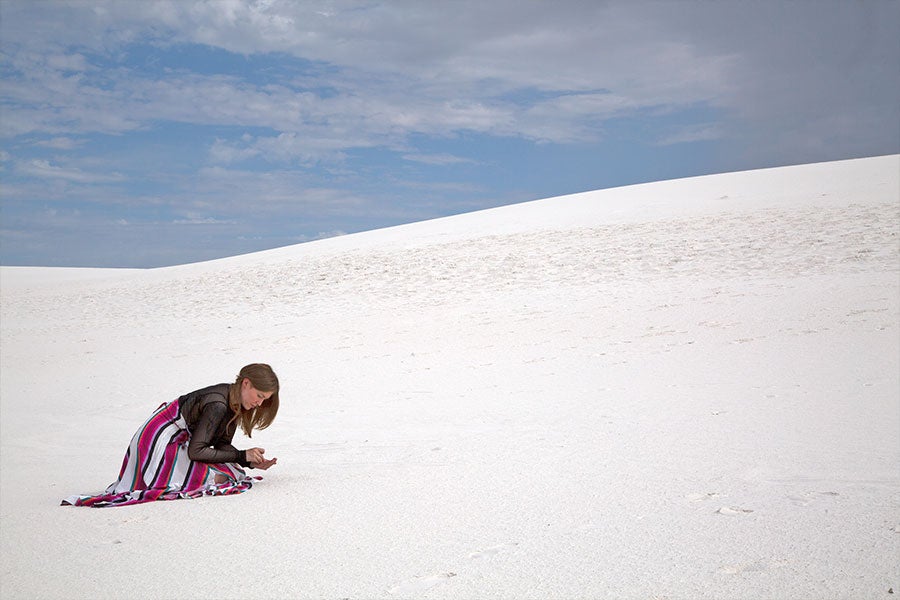
Artist Sarah Nance '09 at White Sands, New Mexico
“That little hook was enough,” Sarah says. “And when I came to Luther, I found it to be absolutely true.”
As a Luther student, Sarah created work with found objects, like seedpods and branches she picked up on local hikes. An art major and gender studies minor, she was involved in the music program and took French and biology courses too. “All of those areas of study filtered into my work in one way or another,” she says. “Especially some of the biology classes, where I started to grasp the extent of human impact on the environment, which has become a primary focus of my work.”
Grad school took her to Oregon, a residency took her to Iceland, and faculty positions took her to Richmond, Virginia; Montréal; Dallas; and now SUNY-Binghamton in New York. Wherever she goes, she says, “The work that I make is responsive to the place I’m in.”
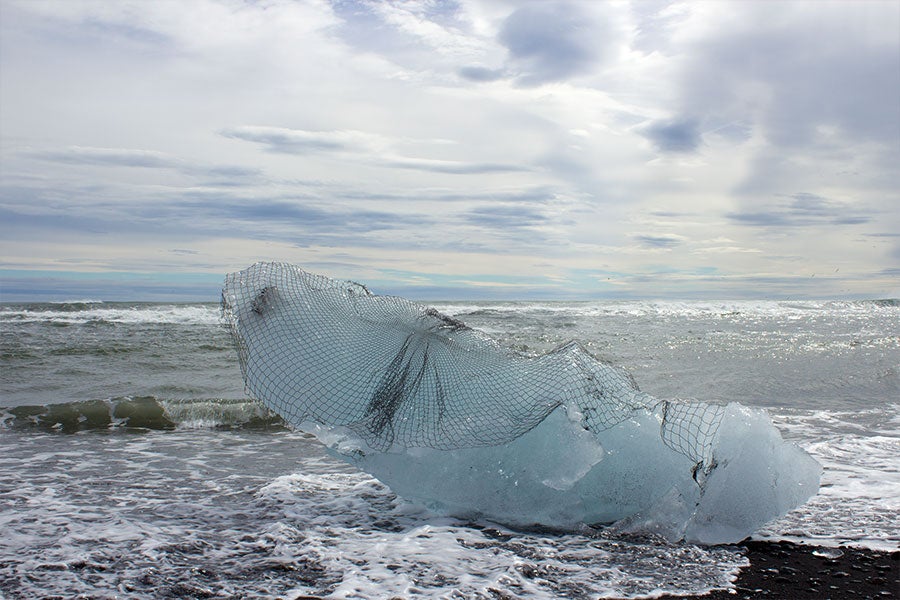
Sarah Nance '09 created a site-responsive installation in Brei∂amerkurjökull, Vatnajökull, Iceland, in 2017 called "to reinforce a glacier."
Sarah’s interested in what she calls “archived landscapes”—mountain ranges that have risen out of glacial silt, for instance, or deserts that were once under an ocean. A related interest is geologic time—time that unfolds on a grand scale—and how, as humans, we can perceive it.
While she works across media—performance, installation, sound, and sculpture—she sees fiber processes as a natural way to express geologic time. “Techniques like knitting, beading, and weaving are repetitive. One unit is repeated many times, resulting in an entirely different surface. That feels sedimentary to me. And something like piecing the top of a quilt brings together a lot of disparate elements; geologic events such as earthquakes and volcanic eruptions similarly create patchworks of differing terrains within a landscape. Fiber processes are also extremely time intensive, like a geologic way of working.”
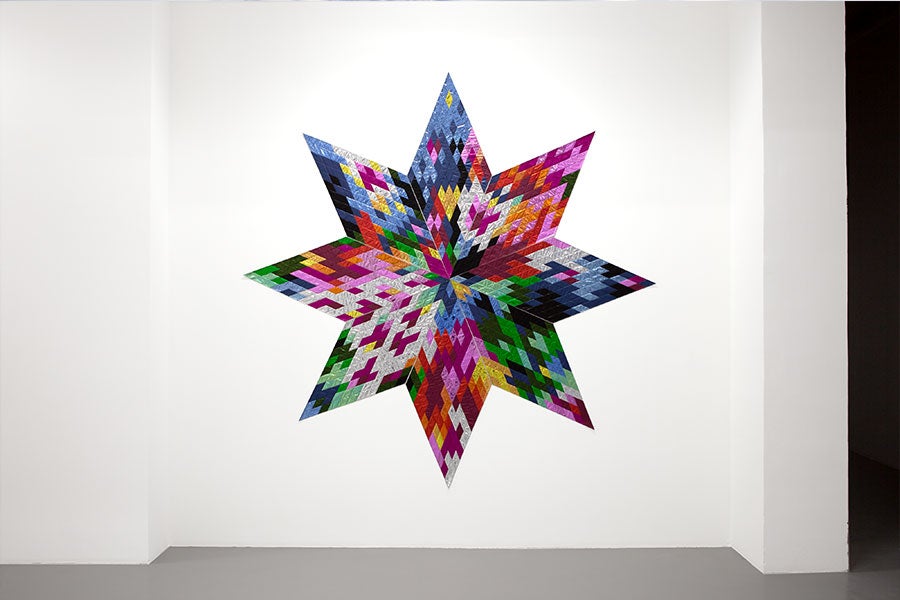
Sarah Nance's 2021 piece "beartooth star ii" is made from quilted mylar.
Ultimately, she says, “My interest is in making work that counters the hyper-intensive speed dominating so many aspects of life and instead offers a slower, more reciprocal experience of a landscape. I try to enter a different idea of time.”
Lately, Sarah has been thinking about mirages and experiences of disorientation in relation to landscape. “I look at what benefits there are in allowing ourselves to feel disoriented, of being acutely aware of not having power over a place,” she says. “How might those experiences change our environmental relationships?”
Find Sarah’s work at sarahnance.com.