Where Service and Science Meet
Growing up, Esther Bitijula’s mother was a model for serving her community. From caring for orphans, to holding women-empowerment workshops, to volunteering in hospitals, she sparked a passion in Esther to make a similar impact.
Esther attended Waterford Kamhlaba United World College of Southern Africa, then made her way to Luther, where she majored in psychology and social work.
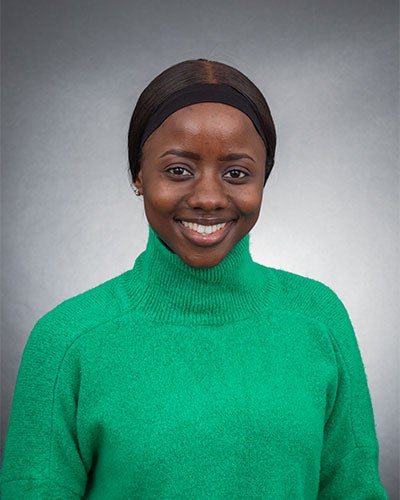
Esther Bitijula ’25
“Psychology gave me tools to understand behavior, emotion, and mental health, while social work really grounded me in systems of equity, advocacy, and access,” she says.
“The combination of fields helped me realize that caring deeply wasn’t enough for me—I wanted to probe behind what I intuitively knew. I wanted rigorous training and diverse perspectives. Sometimes psychology focuses on what’s wrong with a person, but social work focuses on what’s wrong with a community. Studying both fields was my way of saying that I want to care well, but also competently and responsibly.”
As a Luther student, Esther earned a $10,000 Davis Project for Peace grant to work with women with physical disabilities in her home country of the DRC Congo, offering workshops on mental health, social empowerment, and financial literacy, and teaching income-generating skills.
“Empowerment is not something that you give to someone; it’s something that you cultivate together. It required humility, listening, and consistency, which is something I learned in my majors. I was connecting theories I learned in class to real-life experiences,” she says.
As a student assistant in the Forgiveness Lab, directed by Luther psychology professor Loren Toussaint, Esther fell in love with research. “I wasn’t there as a passive assistant—I was really actively trained as an emergent scholar, asking rigorous questions,” she says. “That’s where I began to understand that behind every intervention, every assumption, and every policy, there must also be evidence.”
Esther graduated into a difficult job market for young workers, but her deep experiential learning landed her a research assistant position at Wayne State’s Trauma History Investigation of Neurodevelopment in Kids (THINK) Lab. The THINK Lab furthers understanding of how early-life adversity, trauma, and environmental exposures influence brain development and mental health outcomes in people of all ages.
“It’s a beautiful place to grow intellectually,” Esther says.
Esther currently supports a THINK Lab critical trial that uses clinical assessments, neurological imaging, and physiological measures to assess the efficacy of cannabidiol in combination with cognitive behavioral therapy to treat general anxiety disorders.
The work has piqued her interest in pursuing clinical psychology because of its ability to provide both therapy and rigorous evaluation and to improve interventions used in the field. After further schooling, she’d love to design and test evidence-based treatments that are culturally responsive and accessible to marginalized communities.
“I want to remain in spaces where science and service meet,” she says, “and where we don’t have to choose between data and dignity.”