Samarbeid
In the 1870s, shortly after its founding in 1861, Luther College saw value in preserving immigrant stories and Norwegian artifacts, so it started a collection of objects on campus. In 1933, the collection was moved to its present site. In 1965, Vesterheim became an independent nonprofit museum.
But independent doesn’t mean siloed. Because of our shared history, Luther students have incredible access to an internationally renowned museum—featuring 33,000 artifacts, 12 historic buildings, and a host of experts—and they get to do hands-on learning there.
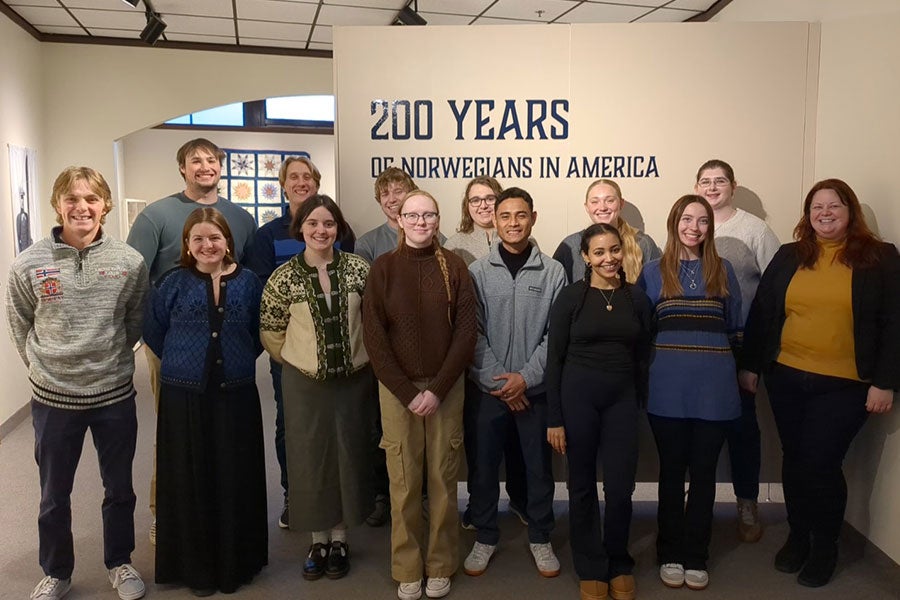
Luther students in a Scandinavian Immigration History course (pictured with professor Anna Peterson, far right) had the exciting opportunity to help create Veseterheim’s landmark exhibit exploring the 200th anniversary of organized emigration to the U.S. from Norway.
A Nexus of Learning
Luther faculty across disciplines leverage the national treasure in Luther’s backyard to provide vivid, real-life experiential learning. One towering example of this is history professor Anna Peterson’s Scandinavian Immigration History course, which she teaches every other year. In fall 2024, students in the course had the exciting opportunity to help create Veseterheim’s landmark exhibit exploring the 200th anniversary of organized emigration to the U.S. from Norway.
Chief curator Laurann Gilbertson drafted a list of potential objects for students to use. Students worked in pairs to research their chosen object and its significance to the larger history of Norwegian immigration. They wrote the text for the labels that museum visitors encounter, gave public presentations, and recorded podcasts about their objects.
Check out the podcasts that Luther students made on the Vesterheim's YouTube channel.
“This was a unique opportunity for students to work with a professional organization,” Peterson says. “And this wasn’t a student exhibit; it was a normal exhibit that students got to play a role in. Vesterheim trusted me and the students to do good work. That relationship is special.”
Isaac Roberts ’24, who researched a drawing of a farm for the exhibit, secured an internship at Vesterheim the following semester, working on an exhibit about a magazine called Kvinden og Hjemmet (The Women and The Home). “The gallery talks that I was able to do both during my internship and the previous semester really stood out to me,” Roberts says. “They were wonderful opportunities to feel like I reached a finishing point in my work and also to meet the public and have other people interested in the work I did!”
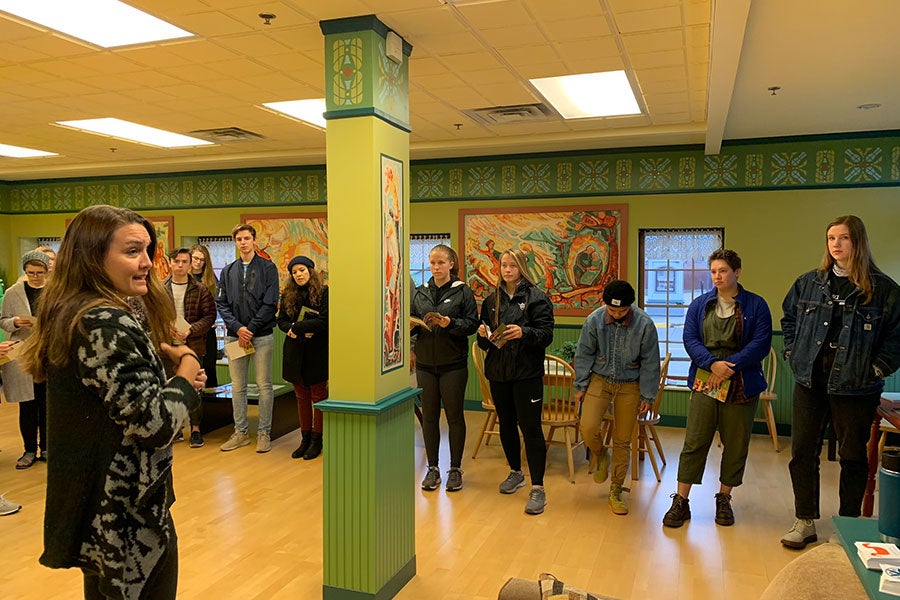
Vesterheim collection manager Jennifer (Johnston) Kovarik ’95 helps teach Luther anthropology students about Norwegian American gift-giving traditions.
Other disciplines, from English to Nordic studies and beyond, also use Vesterheim to augment student learning. Each semester, professor of anthropology Maryna Nading teaches a cultural anthropology course that uses gift-giving as a lens to explore human behavior, culture, identity, and economics. When she takes students to the museum, collection manager Jennifer (Johnston) Kovarik ’95 explains how gift-giving impacted Norwegian Americans at all stages of their lives and lets students handle objects traditionally given from birth to death.
Adrianna Tam, assistant professor of music and director of Aurora, approached Vesterheim twice to create a collaborative program, first centered on the Migrant Quilt Project when it came to Luther, then centered on Vesterheim’s Leading with Our Hearts exhibit of Ojibwe, Saami, and Nordic art. Both times, Tam assembled repertoire inspired by the exhibits and co-organized a multidisciplinary event at which Aurora sang.
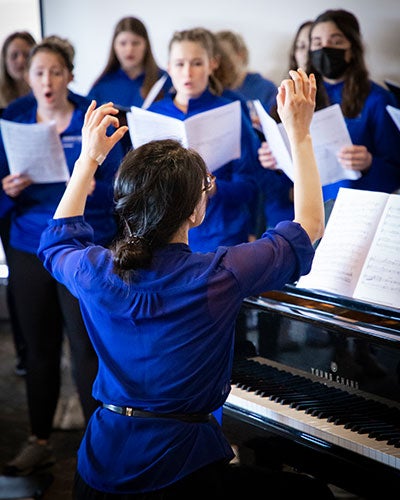
Adrianna Tam, assistant professor of music and director of Aurora, approached Vesterheim twice to create a collaborative program
“I’m the type of person who can spend hours in a museum, so I often look to Vesterheim and other local organizations for sources of inspiration when programming for my ensembles,” Tam says. “When students witnessed the connecting thread between diverse cultures that use quilts to preserve both loving and harrowing memories, the music they were singing became, in a sense, more tangible. Collaborations like these encourage my singers and me to engage in our greater community and continue growing our ever-widening fields of learning.”
An Unmatchable Resource for Museum Studies
For Luther’s museum studies program, Vesterheim is indispensable. Destiny Crider, who directs the program, takes student in her fall-semester class there to learn about how museums handle public-facing projects like exhibit design and communication. In the spring, she takes a class there to learn about behind-the-scenes work like collections management and the ethics and professional care of objects.
“Talking to the people who actually do this work is memorable for students,” Crider says. “Being able to access professionals who understand Luther and are connected to the college makes it less intimidating.”
“It felt like a partnership rather than receiving knowledge from a higher entity,” says Louis Breimhurst ’27, a museum studies minor who toured a Vesterheim exhibit as part of Crider’s class last fall. Breimhurst found it invaluable to experience exhibit design in person and to learn from the people, like collection assistant Lauryn (Swigart) Johnson ’22, who do that work. From the flow of information in the space to how readable the signage is from a distance, Breimhurst says, “The characteristics of the physical space are nearly impossible to replicate online.”
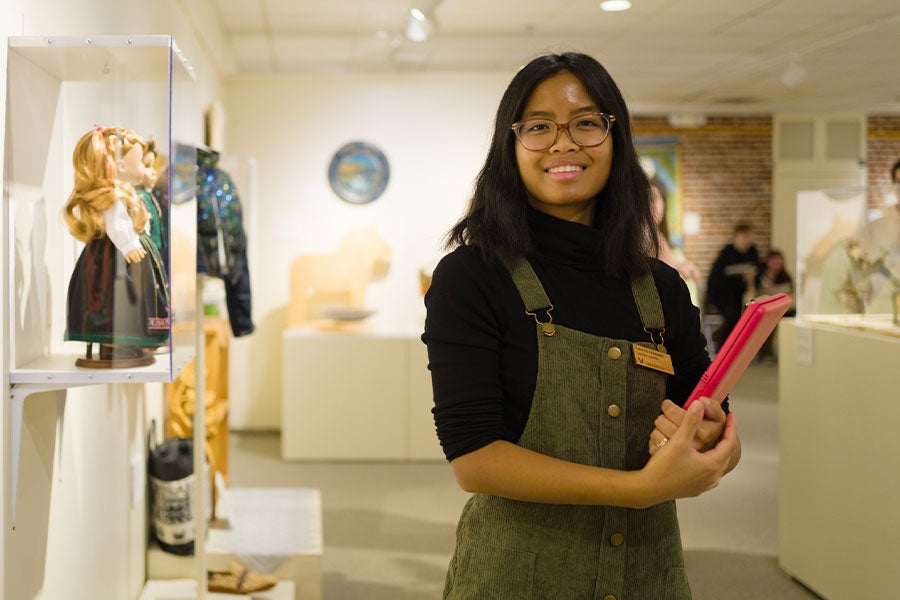
Lauryn (Swigart) Johnson ’22 interned at Vesterheim and now works there as a collection assistant, sometimes helping teach museum studies classes.
The museum is also an unparalleled resource for museum studies students completing their required internship. Lydia Gruenwald ’25, a history major and museum studies minor who’s currently teaching abroad through Fulbright Austria, is interested in public history and how historical narratives are shaped. For her internship, she worked with Crider to create an exhibit in Luther’s Dahl Centennial Union gallery about painter Herbjørn Gausta. The exhibit featured Gausta paintings from Luther’s collection paired with photographs from Vesterheim’s archive that Gausta used as initial studies. “It was a really impressionable experience,” Gruenwald says, adding that learning through that collaboration “made all the difference.”
High-Impact Local Internships
Luther students intern in several capacities at Vesterheim. Megan Miller ’25, an economics and Nordic studies major, interned with the museum’s donor relations team.
During her internship, Miller learned a lot about how an organization stays visible in a community. “Maintaining momentum around a cause that matters—even the most important of causes—takes more work than most realize,” she says. “I spent a majority of time outreaching to constituents and preparing for events. Doing this allowed me to learn so much about prospecting and sales, laying the groundwork for what I do today.”
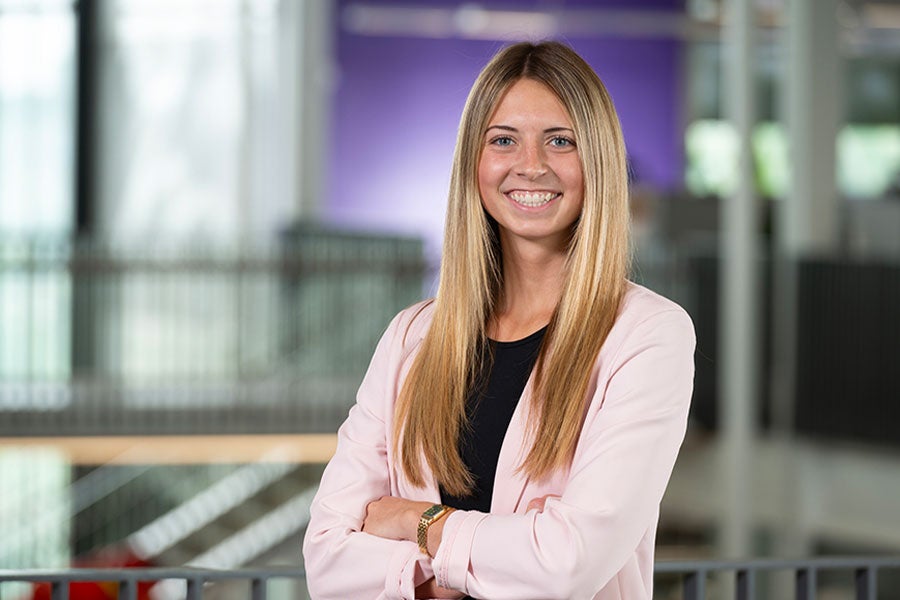
Megan Miller ’25 interned with Vesterheim's donor relations team and now works as a benefits consultant at Holmes Murphy in Des Moines, Iowa.
Today, Miller is a benefits consultant with Holmes Murphy in Des Moines, Iowa, consulting with companies on the benefits packages they offer to employees.
Her experience at Vesterheim and in the Nordic studies major more generally, she says, “gave me the aptitude to consider new perspectives and understand why different people might be approaching the table. This has served me well—of course in sales, as my job is to understand perspectives and shed light to new perspectives that also sit at the table—but more importantly in life. The ability to genuinely connect with others is differentiated by your decision to merely hear or to genuinely listen. Some of my favorite new connections are with individuals who, on paper, couldn’t be more different from me. But I believe that Luther, Nordic studies, and Vesterheim have better equipped me to approach new situations, people, and perspectives with hope and empathy, paving the way for genuine connections. Productive connections.”
The benefits of student internships are mutual. Gilbertsen says, “It’s been such a blessing for Vesterheim to have such top-notch, top-quality Luther students available to us.”
Relationships beyond Graduation
Roughly one-third of Vesterheim’s employees are Luther grads—including its president, Chris Johnson ’87.
Sometimes, a Luther student transitions from intern to full-timer, as did Lauryn (Swigart) Johnson ’22. She photographed items from the collection as a Luther student, then received a job offer to work as a collection assistant after graduating. An art major and museum studies minor, Johnson now works with traveling and temporary exhibits as well as with Vesterheim’s National Norwegian-American Folk Art Exhibition, a biannual event showcasing contemporary artists making work rooted in Norwegian traditions.
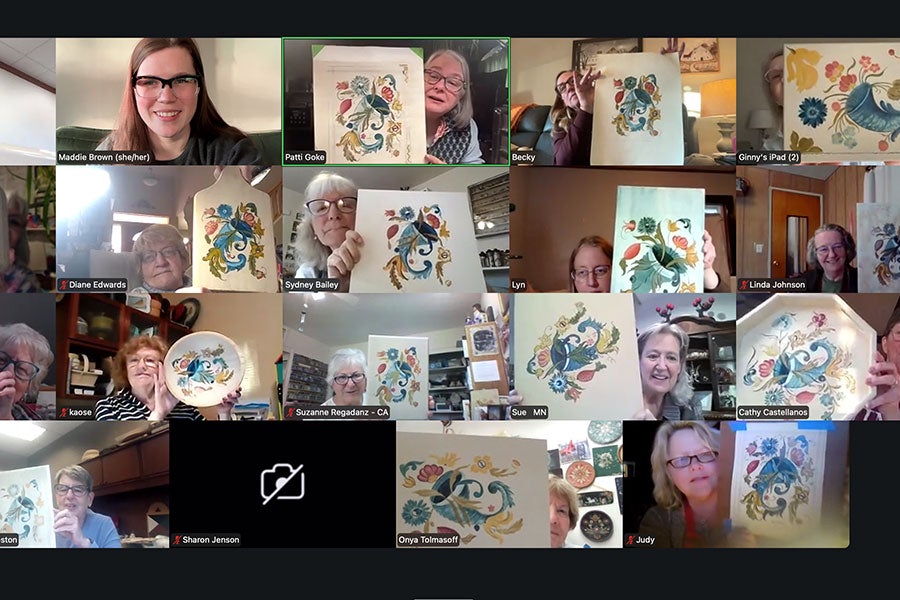
Maddie Brown ’23 (upper left), Vesterheim’s folk art education coordinator, started out as an intern and now helps teach and coordinate Vesterheim courses.
Andrew Ellingsen ’03 and Maddie Brown ’23 work in Vesterheim’s folk art education department, which Andrew directs. Like Johnson, Brown transitioned from intern to employee, but Ellingsen came to the work differently. After spending two decades as an elementary school music teacher, he took a Vesterheim class learning how to make Saami-inspired bracelets and fell in love. Over the course of the following year, he made an astounding 500–700 bracelets.
When a position opened in Vesterheim’s folk art school, Ellingsen jumped at the chance. This was less than a year into the pandemic, so he was part of the team—with critical help from Luther professor Maren Johnson, who has also taught language classes for Vesterheim and serves on its board—that worked to adapt the folk school’s courses to an online format.
The online format was wildly successful. Pre-COVID, Vesterheim taught only in-person and hosted 600–1,000 students from 30 states each year. In 2025, through online and in-person classes, it taught 5,000 students from all 50 states and 30 countries.
Luther alumni are part of the cohort that teaches these classes. Some—like Berit Skogen ’23, Evelyn Galstad ’20, Nick Rogness ’24, and Lianna (Stewart) Torres ’17—teach language classes. Sometimes they also teach unique one-off classes, like Galstad’s free family class on Norwegian songs or Rogness’s class about life north of the Arctic Circle.
Some alumni, like James Miller ’19, who was the museum’s youngest ever gold medalist woodworker, teach folk arts. Sometimes, Vesterheim helps launch an instructor’s folk art career, as it did with Maeve Gathje ’15.
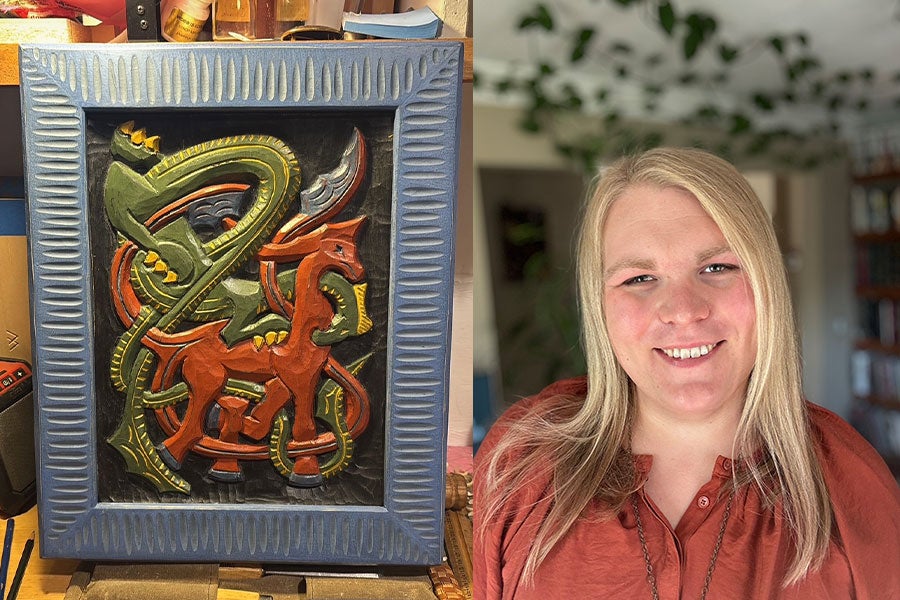
Maeve Gathje '15 got her start learning and teaching folk arts at Vesterheim. She's now a working artist who teaches throughout the Midwest.
In 2013, Gathje took a J-Term course—Scandinavian Fine Handcrafts—with the late Harley Refsal, renowned woodcarver and Luther professor emeritus. In the course, students explored Vesterheim’s wooden objects, then carved a spoon of their own—and ate ice cream with it. “In many ways, that class changed the trajectory of my entire life,” Gathje says. As a working artist with a diverse practice of her own, she teaches at folk art institutions throughout the Midwest.
In the 10 years since graduation, Gathje has repeatedly visited Vesterheim for inspiration. “Having access to historical objects has been important for me to ground my work in time and place,” she says, adding that “Luther students having Vesterheim essentially at their doorstep is an incredible gift. It’s a place of many horizons and many paths of inquiry to follow. Whether that’s learning about woodcarving, weaving, immigration, culture, or any other number of subjects, it’s a good place to start asking questions.”
Vesterheim’s education branch continues to be an important partner in Luther J-Term courses. Refsal died in 2024, but the course that launched Gathje’s interest is now taught at Vesterheim by Twin Cities–based Fred Livesay. In January 2024, Ellingsen collaborated with Maren Johnson to offer one of Luther’s very first international J-Term courses for first-year students: Nordic Tales and Traditions, in Norway.
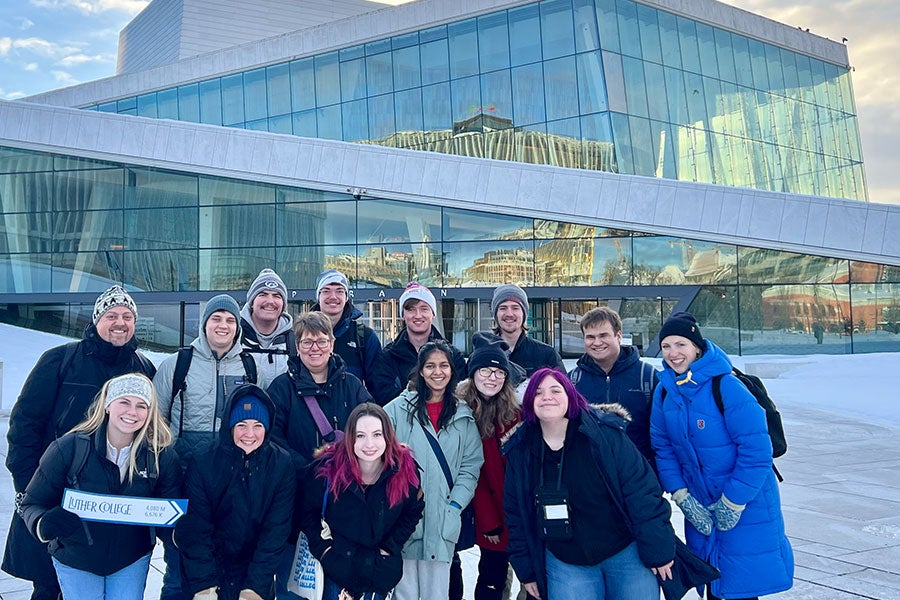
Andrew Ellingsen '03 (far left), Vesterheim director of folk art education, co-led one of Luther's first J-Term courses for first-year students.
Luther alumni also serve as Vesterheim volunteers and board members, including its chair, Brian Rude ’77.
Because of our shared history, Luther students, staff, and faculty get free admission to Vesterheim. This can be part of the glue that connects a student to their college town for life. “Having access to Vesterheim not only hooked me into history and museum studies,” says Gruenwald, “but it also made me fall in love with Decorah!”
Continuing to Explore Together
As we move beyond 2025 and the special anniversary it marked, both Luther and Vesterheim will continue to explore the story of immigration, how we tell that story, and what it has to teach us. We’ll do this as entities with a shared history—and also a shared future.