Learning That Opens Doors to the World
Luther is one of just a handful of places in the country where undergraduates can major in Nordic studies. We’re the only college with an endowed Nordic studies center, the Richard L. and Judith A. Torgerson Center for Nordic Studies.
Our Nordic studies program is rare—and popular. Each semester, about 125 students take a class in Norwegian language or Nordic culture, and the three introductory-level Norwegian language classes are always full. In May 2025, the major graduated its second-largest class, a year behind graduating its largest class ever, in May 2024.

Nordic studies program director Maren Johnson (right) advises students.
Asked why Nordic studies is so popular, program director Maren Johnson says, “I think the draw for students these days is thinking about questions that are really pertinent to our community here—questions about sustainability, about social and environmental justice, about immigration. The Nordic model provides an alternative to how things are governed in the United States, and students are curious about how those choices are made and the value structures that inform those choices.”
The program teaches language and culture, and it takes a hard look at social democracy, environmental policy, and entrepreneurship. But at its core, Nordic studies at Luther is about preparing students to be global citizens. It asks them to develop intercultural knowledge and skills, to understand different practices and perspectives, and to connect with people in the wider world. Luther students are hungry for this.
Synergistic Partnerships
Nordic studies is naturally interdisciplinary. It spans fields like economics, management, education, healthcare, sociology, anthropology, political science, history, environmental studies, and more. All 14 students who graduated from the Nordic studies program last May were double majors, with education and visual communication majors being especially popular complements.
Levi Bird ’21 sums up the appeal of the program: “When I first came to Luther, I had so many different interests and felt pulled in so many directions, especially between the social sciences and the humanities. It really felt like I needed to make this concrete decision between them. But with Nordic studies, there’s the opportunity to explore so many aspects of human expression and society.”
Not only is Nordic studies a natural complement to other fields, but the program also intentionally partners with other academic departments to leverage opportunities for students.
One special partnership it’s developing is with the economics, accounting, and management (EAM) department. Ryan Torkelson ’07, associate professor of accounting, spent the spring 2024 semester cultivating internship sites for EAM and marketing students both in the U.S. and in Norway. He hopes that students will soon be able to find placements in Norway at the American Chamber of Commerce, the Norway-American Foundation, the Oslo Chamber of Commerce, and the Minnesota Brand Agency (yes, in Norway!). Closer to home, he’s eyeing Norway House’s Minneapolis-based Business Accelerator Resource Network (BARN), a first stop for Norwegian companies hoping to launch in U.S. markets. “BARN wants to do more market research,” Torkelson explains. “The data analysis they need would lend itself really well to our new marketing major.”
EAM’s partnerships in Norway are still in their infancy, but there are Luther-Norway partnerships that are already thriving in Luther’s education department.
Learning Outside Comfort Zones
Elliott Johnson, associate professor of education, was eager to leverage the strong relationships that Luther has forged in Norway. By placing student teachers in international schools there, he says, “They get a view of the bigger world. Our schools in the United States are diverse, but they’re diverse in different ways. The international schools in Norway let them work with students coming from all over the world in one particular classroom. By having that experience, they then are better prepared to work proactively in classrooms here in the United States that may not have as much diversity, but they will have some, and they’ll be better prepared to work with all different types of learners.”
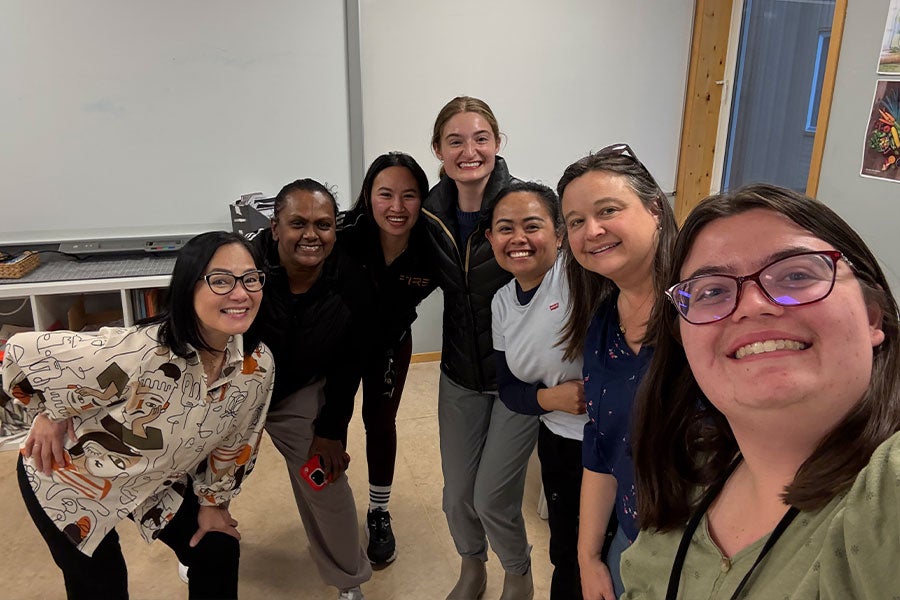
Cherise (Storlie) Storlie-Kristoffersen ’97, principal of Fagerhaug International School, mentored Bella Bamlett ’25 and Elena Conklin ’25 as they did their student teaching at her school last fall. From left: Lani Avila Stav, Christine Padachie, Shiela Estoconing, Elena Conklin, Jonilyn Storseth, Cherise Storlie-Kristoffersen, Bella Bamlett.
Kristiansand International was Luther’s first partner school when international placements resumed post-COVID, and Johnson has since expanded the program to schools in Trondheim, Asker, and Stjørdal, where Cherise (Storlie) Storlie-Kristoffersen ’97, originally from Mabel, Minn., is principal of Fagerhaug International School.
“To watch all the small miracles and to guide the ways in which we structure our days and learn together in a small school is a true gift,” Storlie-Kristoffersen says. Last fall, she took on two Luther student teachers, Bella Bamlett ’25 and Elena Conklin ’25.
Bamlett was nervous about traveling so far from home, but the International Baccalaureate (IB) program taught at Fagerhaug intrigued her. With an endorsement in special education, she was eager to look outside familiar education systems to learn all she could to help her future students. When she found out that Conklin was also interested, she says, “I knew I was on my way to purchasing my plane tickets!”
Conklin taught in a classroom of 14 students, only three of whom spoke English. “I especially leaned on nonverbal communication and worked hard to create relationships with students despite our language barriers,” she says. “I learned many strategies for how to teach in a language-immersion environment, which has prepared me to confidently work with English language learners in the future.”
Conklin also plans to incorporate the idea of “outdoor school” (uteskole) that’s common in Norway, as well as the IB curriculum’s emphasis on teaching students how to be global citizens that appreciate and celebrate all cultures.
One thing that Bamlett would like to bring to her next classroom is the idea of developing lifelong learners. She shares, “The IB curriculum includes something called learner profiles. Teachers incorporate these profiles into academic assignments to aid students in developing skills. One example of a learner profile is risk-taking. In order to be a risk-taker, a student has to partake in things they may not be super comfortable with. So a teacher may give a student a task that they know the student is going to struggle with, but the teacher states to the student that they need to be a risk-taker and at least try the problem. By teaching these skills to young learners, I feel it will aid them not only in developing the skills needed for the classroom but also for life after they finish their educational journeys.”
Storlie-Kristoffersen was impressed by what Conklin and Bamlett brought to her school: “Bella and Elena were ready to meet new experiences with a positive attitude, and they were ready to learn and share knowledge. Luther had prepared them to be open-minded, caring, principled, and reflective.”
Since spring 2020, Luther’s education department has placed 10 student teachers in five schools across Norway. “Our students are appreciating these opportunities to see other formats of how to teach that may or may not fit with their own teaching styles,” Johnson says. “They experience things that make them question: How may I make change in what I do in order to best impact students? When they talk about those opportunities of learning and growing, that makes me excited about what we provide them in preparation for going out and being full-time teachers.”
How Cultural Exchange Can Impact a Classroom
Newelle Dalton ’24 taught at Kristiansand International School in fall 2023. She was drawn to teach in Norway because of the country’s emphasis on student-centered learning and the opportunity, she says, “to bring new perspectives, cultural awareness, and adaptability to my future classroom. In the end it was the best thing I did for myself! It truly led me to believe in myself and my teaching.”
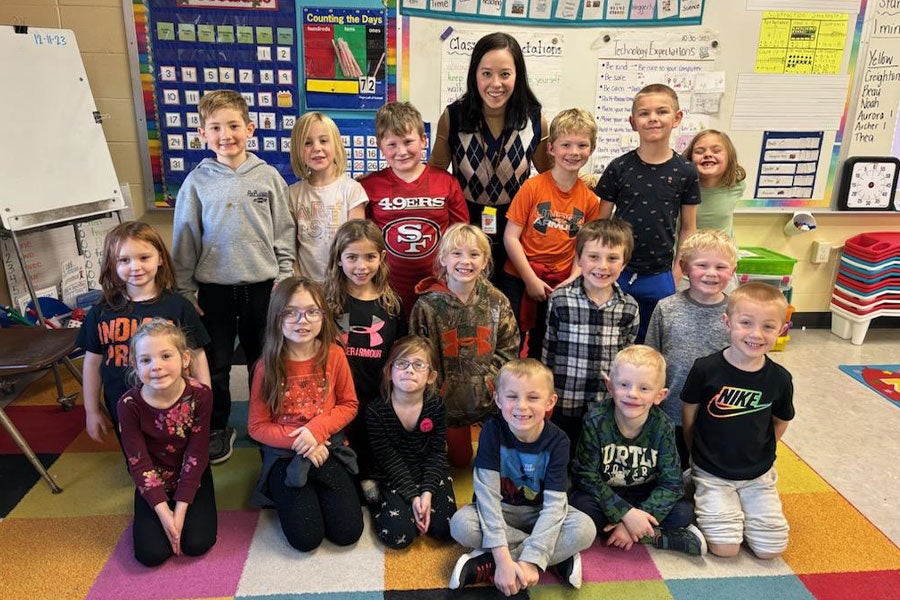
Newelle Dalton ’24 did her student teaching at a school in Kristiansand, Norway, and brings what she learned there to her current work with third graders in Minnesota. “My students are always captivated by my adventures abroad,” she says. “They ask so many inquisitive questions about the culture and country, and we even learn a bit of Norwegian together!”
She continues, “So much of the learning that I had the ability to be a part of with my students in Norway felt shared at all times. Students had an incredible amount of agency, self-efficacy, and community involvement regarding their learning. It felt like a mutual learning experience because my students were so independent and creative.”
Now, as a third-grade literacy teacher at Johnsville Elementary in Blaine, Minn., Dalton sometimes feels rushed to fit in assessments and required curriculum. But her time in Norway, she says, “prepared me to be flexible, to support students through questioning instead of lecturing, to connect with students before all, and to use restorative justice practices in the classroom.”
It also encouraged her to involve the community in her students’ education. She invites community speakers to her classroom, and last year she and her students visited a nursing home, delivered candy bags to local business owners, made cards for veterans, and made placemats for the elderly for Thanksgiving. “These acts of service and hospitality were directly inspired by my time at Kristiansand International School, where teachers were encouraged to integrate community engagement into everyday learning,” she says.