How to Study Smarter (Not Harder) for Finals
Three months of notes, four exams next week, and I have not started studying. I have been there more times than I should probably admit.
The worst part is not even the amount of material. It is the guilt of knowing I had all that time. Preparing for finals is about studying smarter, and most of us were never taught how to do that.
How I learned that repetition matters, and why
I used to re-read my notes the night before an exam, and it never worked. Within a day of learning something new, we forget more than half of it unless we go back to it. That drop is called the forgetting curve. So when I cram the night before, most of it is gone before I even sit down to take the exam.

Luther student studying on campus.
So now I go back to the same topic more than once. A day later, then three days later, then a week later. Each time I have forgotten a bit of it, and having to remember it again is what makes it stick. This is called spaced repetition, and Anki and Quizlet are built for it. When I come back to a topic and some part of it still confuses me, I ask AI to explain it as simply as it can. It breaks the hard parts down into easy words, and once I actually understand it, it sticks much better.
It is always best to start early, so if you are reading this, start now.
How I figured out what to actually study
I used to open the first chapter and work forward, which meant I spent the most time on things I already knew. Studying what you are good at feels great. It is also how you run out of time before you reach the stuff you cannot do.
Now I go through the topics from the syllabus and mark each one as either no idea, sort of know it, or could teach it. Then I start with the no-ideas, because those are the ones I will lose points on. The sort-of-knows come after that, and I leave the could-teach-its until the end.
My pretty notes were not studying
I have spent a lot of time making really attractive notes that I planned to revisit and never did, which feels like effective study but actually wasn’t. Copying things down is not the same as remembering them, and you find that out in the exam. Highlighting and re-reading turn out to be two of the least useful things you can do.
So now I do the opposite. I close my laptop, take a blank sheet of paper, and write down everything I remember about a topic without looking at anything. Then I check what I missed. Explaining it out loud works too. I teach mine to my roommate when we have the same exam, or I go into an empty classroom and write the whole thing on the whiteboard. If nobody around you is in your class, the Center for Academic Enrichment (CAE) offers free peer tutoring, where another student who has already taken the class sits down and goes through it with you. It can feel uncomfortable at first, but that’s exactly how you find the things you still need to work on.
Checking whether I actually understand something
Richard Feynman is someone I look up to a lot. He was a Nobel Prize-winning physicist, and he had a rule for understanding things: “If you can’t explain it simply, you don’t understand it well enough.”
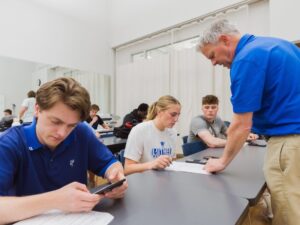
Students working with professor in class.
- Explain the topic in the simplest words you can.
- The moment you get stuck, you have found the part you have not understood.
- Go back to the material and revise that part.
- Explain it again, until you get through without stopping.
This works because it forces you to confront the difference between recognition and understanding, from “yes, I have seen this before” to “I can explain it to someone else without looking at anything.”
Working with my attention instead of fighting it
We have all sat down to study and gone from Instagram to YouTube to reels. Twenty minutes in, and somehow two hours are gone.
One thing that has helped me is the Pomodoro technique. I stopped trying to sit down for long hours at a time and work in short blocks instead:
- Study or work for 25 minutes.
- Take a 5 minute break.
- After four rounds, take a longer break of 15 to 30 minutes.
- During the session, do not check your phone or quickly look something up.
- On the break, actually stop. Go for a walk, call your parents, drink water.
- Switch subjects between rounds if you have more than one exam coming up.
I have noticed that a few hours of focused work gets me further than a long session where I am distracted.
Sleep beats an all-nighter
I have thought about pulling all-nighters all the time, and I have tried it, and it has never worked. I get through the material but almost none of it is there the next morning, and I sit the exam tired on top of it. I would take 5 to 6 hours of sleep over another few hours of unfocused studying any day. Whatever I go over before sleeping also stays with me better than anything I cram at 3 a.m.
Why past exams are the one thing I always do
If there is one study habit I would keep above everything else, it is doing past exams under timed conditions, without looking at notes.
First, finish the practice paper your professor gives you, on time. Questions from it are the most likely to show up on the exam. Ask what the format will be. If it is essays you need to practice writing them, not just recognizing the right answer. Then mark yourself honestly. The mistakes are the most valuable part, and by exam day the questions do not feel new anymore.
Managing test anxiety
I can know the material and still go blank the moment the exam is in front of me. That is test anxiety, and it is not the same as being nervous. Sometimes the stress is what stops you from starting at all.

Luther students studying together outside.
This is what helps me:
- Not studying in the same place every day. If I have been in Preus too long, I go find an empty classroom.
- Getting out of my room for a while, even if it is just a walk around campus.
- Cleaning my desk before I start, and getting a warm coffee.
- Making a schedule before exams start, so that during exam week I am only reviewing. If you have never done this before, the CAE has academic success coaches who will build one with you.
- Keeping my phone away from my bed, because it makes it harder to fall asleep.
Most of it is about getting started instead of putting it off for another hour.
You got this
If I forgot everything else, I would keep four things:
- Review early and often, not the night before.
- Test yourself instead of re-reading.
- Do past exams under timed conditions.
- Sleep.
Good study methods only work if you are honest with yourself about what you actually need. Some people study better with friends, others alone. Some learn by writing things out, some by saying them out loud, some by drawing diagrams.
And sometimes studying is hard not because you are lazy or not smart enough, but because you are tired, or stressed, or dealing with things outside school. It is important to recognize that and take care of your mental and physical health first. The exam is not the end of the world. The point is not to memorize but to understand, and to carry something out of the classroom with you.
As a great man once said, “Don’t chase success. Pursue excellence, and success will follow you.” That is from 3 Idiots, one of my favorite films.
Good luck for the exams. You got this.
Additional Resources
- Counseling Service: free for students, in Larsen Hall
- CAE study skills workshops: held through the semester
- CAE free peer tutoring: go through a class with a student who has already taken it
- CAE academic success coaches: help you build a study schedule
- CAE time management planner: a planner you can print and fill out
Related Posts
What does it mean to be an undergraduate summer researcher? How do I find an opportunity to research? What’s it like to stay at college during the summer? Read on to find out how to become an undergraduate summer research student, what daily life is like, and what students say about the benefits of spending a summer on a research project.
In this post, you’ll learn about Megan’s experience as an elementary education major with a reading endorsement, as well as a psychology minor.
Admissions Office
Luther College
700 College Drive
Decorah, Iowa 52101
Phone: 563-387-1287