Dan Davis
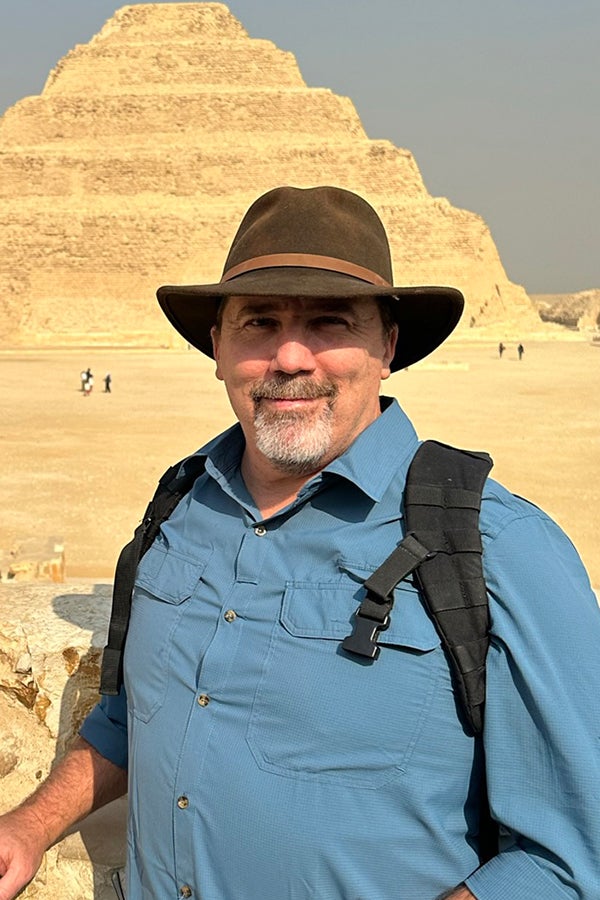
Orlando W. Qualley Chair of Classics
About
Education: Ph.D., Classics, University of Texas; M.A., Nautical Archaeology, Texas A&M University; B.A., Classical Civilizations, University of Iowa
Associate Professor Dan Davis, a native of Des Moines, Iowa, has been at Luther since 2011. He teaches Greek, Latin, and classical studies courses, including Greek and Roman archaeology, Greek and Roman civilization, ancient explorers, and marine archaeology. He also contributes to Paideia, Luther’s signature writing and critical-thinking course for first-year college students. His research interests include Greek, Roman, and Byzantine seafaring, navigation, and maritime culture; deep-water archaeology using robotics and other remote methods; ancient harbor technologies; maritime trade; and aviation archaeology in the search for and recovery of MIAs from America’s past conflicts. He is currently writing a book on navigation in the ancient Mediterranean.
Dan is involved in three major archaeology projects.
Kenchreai Coastal and Marine Survey (KCMS) 2026-2028
Kenchreai, the Aegean port town of ancient Corinth in central Greece, is an Archaic, Classical, Hellenistic, and Roman-era site that lies half submerged beneath the clear waters of the Aegean’s western Saronic Gulf. KCMS employs archaeological, architectural, geophysical, and geological methods to examine the site’s long-term human and environmental development in a tectonically active coastal zone. The project falls under the overall direction of Dr. Joseph Rife (Vanderbilt University, American School of Classical Studies at Athens) and Paraskevi Micha (Ephorate of Underwater Archaeology). Davis serves as field director for underwater investigations, focusing on submerged architecture atop the harbor’s massive moles and breakwaters, plus nearby shipwrecks both within and outside the harbor zone.
The project involves undergraduate students from Luther, Vanderbilt, and other institutions, including the University of Iowa, University of Delaware, University of Georgia, and Memphis College. Luther College students can earn credit, including toward the EXPL general-education requirement. Interested students should email dan.davis@luther.edu.
Ancient Shipwrecks in the Deep Sea
From 2008 to 2013, Davis served as a marine archaeologist on E/V Nautilus expeditions in the Aegean, Black, and Mediterranean Seas, led by Dr. Robert Ballard and Dr. Michael Brennan. Using the remotely operated vehicle (ROV) Hercules, the team discovered 50 deep-water shipwrecks, primarily dating from the sixth century BCE to the sixth century CE. The project is now in its research and publication phase, with several articles already appearing in peer-reviewed journals.
Davis, D., A. Opaiţ, and M. L. Brennan. 2024. “The Knidos W Shipwreck: A Tile Carrier from the 1st Century B.C.” Skyllis 39, 40-57.
Davis, D., A. Opaiţ, and M. L. Brennan. 2022. “The Sinop I Shipwreck: A Black Sea Merchant Ship from the Roman Imperial Era,” in J. Boardman, J. Hargrave, A. Avram, and A. Podossinov, eds. Connecting the Ancient West and East: Studies Presented to Gocha Tsetskhladze, 633-646. Leuven: Peeters.
Opaiţ, A., D. Davis, R. Matheny, and M. L. Brennan. 2021. “A Case Study of Rhodian Wine Export: The Knidos K and J Shipwrecks,” Skyllis 36, 76-90.
Brennan, M. L., D. Davis, A. Opaiţ, and M. Stay. 2020. “Deep-Water Shipwrecks as a Microcosm of Late Roman Maritime Exchange in the Eastern Mediterranean.” Journal of Roman Archaeology 33, 291-329.
Davis, D. and M.L. Brennan. 2020. “The Knidos Q and Marmaris D Shipwrecks: Two Small Vessels with Rhodian Pottery from the Late Ottoman Period.” International Journal of Nautical Archaeology 49.1, 194-202.
Opaiţ, A., D. Davis, M. L. Brennan, and M. Kofahl. 2019. “The Sinop F Shipwreck in the Black Sea: An International Cargo from Late Antiquity,” in H. Kaba, G. Kan Şahin, B. M. Akarsu, and O. Bozağlan, eds. Proceedings of the International Symposium on Sinope and the Black Sea Archaeology – Ancient Sinope and the Black Sea, 13-15 October 2017, Sinop, 77-89. Sinop.
Opaiţ, A., D. Davis, and M. L. Brennan. 2018. “Roman Commerce and Elite Markets in the Eastern Mediterranean: A Case Study of Three 2nd-Century Shipwrecks off Knidos,” in A. Avram, L. Buzoianu, and V. Lungu, eds. Koinè et mobilité artisanale entre la Méditerranée et la mer Noire dans l’Antiquité. Hommage à Pierre Dupont à son 70e anniversaire (Pontica LI, Suppl. V), 299-334. Constanţa: Musée d’Histoire Nationale et d’Archéologie.
Davis, D., M.L. Brennan, A. Opaiţ, and J. S. Beatrice. 2018. “The Ereğli E Shipwreck, Turkey: An Early Hellenistic Merchant Ship in the Black Sea.” International Journal of Nautical Archaeology 47.1, 57-80.
Brennan, M.L., D. Davis, R.D. Ballard, A.C. Trembanis, J.I. Vaughn, J.S. Krumholz, J.P. Delgado, C. Roman, C. Smart, K.L.C. Bell, M. Duman and C. DuVal. 2015. “Quantification of Bottom Trawl Fishing Damage to Ancient Shipwreck Sites.” Marine Geology 371, 82-88.
Brennan, M.L., D. Davis, C. Roman, I.V. Buynevich, A. Catsambis, M. Kofahl, D. Urkmez, J. I. Vaughn, M. Merrigan, M. Duman. 2013. “Ocean Dynamics and Anthropogenic Impacts along the Southern Black Sea Shelf Examined through the Preservation of Pre-Modern Shipwrecks,” Continental Shelf Research 53, 89-101.
Recovering MIAs from America’s Past Conflicts
As Lead Archaeologist and Scientific Recovery Expert for Project Recover at the University of Delaware, Davis supports the Defense POW-MIA Accounting Agency’s mission in locating and recovering American MIAs worldwide. Each summer, he and the Project Recover team discovers, investigates, and documents submerged World War II aircraft to repatriate remains, offering closure to families and the nation—a uniquely American effort. Missions have spanned Greece, Croatia, Denmark, Chuuk (Truk Lagoon, Federated States of Micronesia), the Republic of the Marshall Islands, and the Republic of Palau. To enhance detection, the team is integrating AI and machine-learning algorithms. See recent articles for details:
Character, L., M. Moline, M. W. Breece, E. White, D. Davis, and C. Colbourn, “Deep Learning for Detection of Underwater Aircraft Wrecks from US Conflicts,” Journal of Computer Applications in Archaeology 8(1), 139-155. DOI: https://doi.org/10.5334/jcaa.179
Moline, M. A., C. Colbourn, D. Pietruszka, D. Davis, E. White, M. W. Breece, L. Character, E. Terrill, and R. Hess, “Documenting the First Three U.S. Aircraft Discovered in Truk Lagoon from Operation Hailstone (February, 1944),” Journal of Maritime Archaeology 19, 695-729.
CLAS 310 Ancient Science
This course examines the history of science and technology in the ancient world between 1200 B.C. (when Babylonian astronomical texts emerge) and A.D. 500. Scientific ideas and technological innovations will be placed in their intellectual, social, religious, economic, and political context. Emphasis is placed on the Greek and Roman period, which saw substantial developments in agriculture, astronomy, geography, mathematics, hydraulics, medicine, music, botany, zoology, and meteorology.
GRK 101 Elementary Greek I
The first course of a two-semester sequence emphasizing basic grammar, vocabulary, and syntax of ancient Greek. Translation passages are drawn from different Greek works, including the New Testament.
GRK 102 Elementary Greek II
The second course of a two-semester sequence which continues the study of ancient Greek grammar, vocabulary, and syntax. Passages are drawn from a variety of Greek works, including the New Testament.
GRK 201 Intermediate Greek
A review of ancient Greek grammar, vocabulary, and syntax, followed by readings in both the New Testament and classical authors.
CLAS 300 Classics and Culture
Using texts in translation, this course explores select aspects or themes from the cultures of ancient Greece and Rome. Topics range from consideration of a particular literary genre to the in-depth study of a particular place and time, and to broader explorations of Greco-Roman culture in comparison with other cultures.
LAT 102 Elementary Latin II
The second course of a two-semester sequence which continues the study of ancient Latin grammar, vocabulary, and syntax. Passages are drawn from a variety of Latin works.
- Ph.D., Classics with distinction in Classical Archaeology, University of Texas at Austin, 2009
- M.A. in Nautical Archaeology, Texas A&M University, 2001
- B.A. in Classical Civilizations, University of Iowa, 1996